



AI-powered antivirus and endpoint security
Cloud Bilişim provides AI-powered antivirus and endpoint security solutions for business devices in Türkiye. Device coverage, behaviour monitoring, EDR capabilities, policies and response responsibilities are assessed against your existing systems and licence requirements.
What should an endpoint security pilot check?
Check operating-system support, business application compatibility, device performance and alert handling. Define who reviews incidents and authorises isolation; licensed response capabilities and support scope should be explicit.
Related services and next steps
Cyber security tailored to your industry, Penetration testing services, Contact Cloud Bilişim.
What is AI Antivirus?
AI antivirus is endpoint security software that decides by looking at what a file does when it runs, rather than just comparing it with a known list of malicious files. Thanks to machine learning models and behaviour analysis, it can detect malware that has never been seen before.
This distinction is decisive today. Attackers no longer send the same malicious file to everyone; they produce slightly modified variants for each target, which are therefore not found on any list. For a signature-based scanner, this file is undefined and passes.
Behaviour-based protection, however, queries not the identity of the file the actions : why does it encrypt hundreds of files in a few seconds, why does it delete backup shadow copies, why does it try to spread to network shares? These questions provide the correct answer even if the name of the file is unknown.
We install the endpoint security solution suitable for the number of devices and the way your organisation operates as Cloud Bilişim, configure the policies, and manage the central console together after installation.
What Do NGAV and EDR Mean?
NGAV (Next Generation Antivirus), the threat with behaviour analysis and machine learning blocking It is a layer. EDR (Endpoint Detection and Response) is a step further: it records how the incident started, which devices it spread to, and what it changed; it offers the ability to isolate the device, terminate the process, and undo the changes made.
In short, NGAV closes the door, EDR allows you to see what is happening inside and intervene.
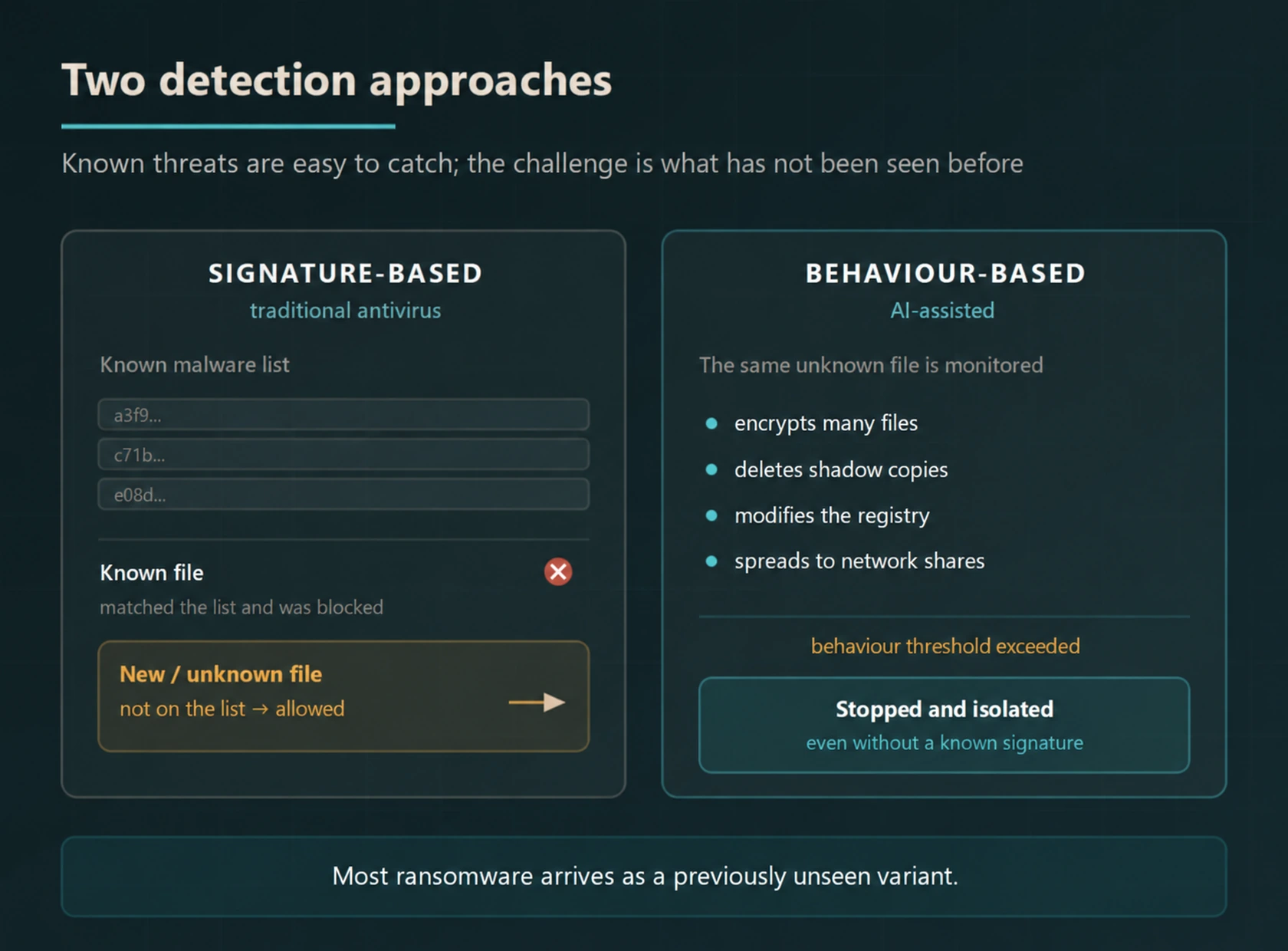
The same unknown file results differently in two approaches: it passes because it is not on the list, or it is stopped due to its behaviour.
The Difference Between Classic Antivirus and AI-Powered Antivirus
| Topic | Classic antivirus | AI-powered antivirus (NGAV + EDR) |
|---|---|---|
| Detection method | Matching with known malware signatures | Behaviour analysis and machine learning |
| Unknown malware | Usually misses it | Can catch it based on behaviour |
| Fileless attack | Cannot see because there is no file | Monitors the process in memory |
| Ransomware | If the variant is new, it lets it through | Stops during encryption behaviour |
| Incident history | Limited logging | Event chain is logged in detail |
| Intervention | Deletes or quarantines the file | Isolates the device, stops the process, reverts the change |
| Management | Mostly device by device | From a single central console |
Does It Actually Provide Protection Against Ransomware?
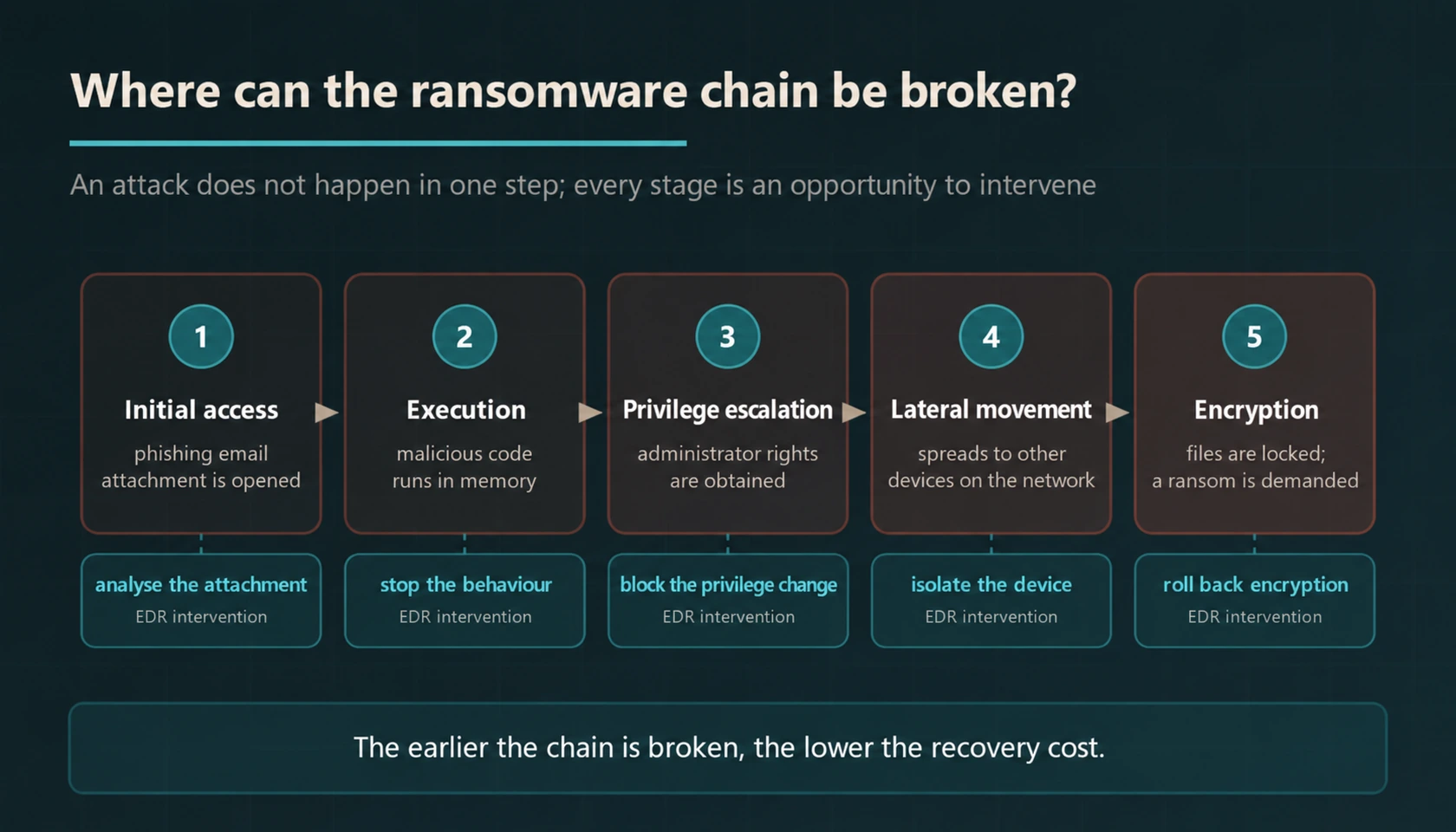
Ransomware does not operate in a single step. It starts with a phishing email, the code executes, administrative rights are obtained, it spreads across the network, and finally files are encrypted. Each step is also an opportunity for intervention; the earlier the chain is broken, the lower the recovery cost.
What Did This File Want to Do?
When a suspicious file is detected, the system does not just block it. The file is run in an isolated cloud environment and there its actions are monitored step by step: which commands it would execute, which files it would touch, where it would spread in the network, how it would harm the system.
The resulting report is the answer to the question “what would have happened if it wasn’t blocked” without anything happening on your real system. This is the most concrete way to explain the incident to management and audit.
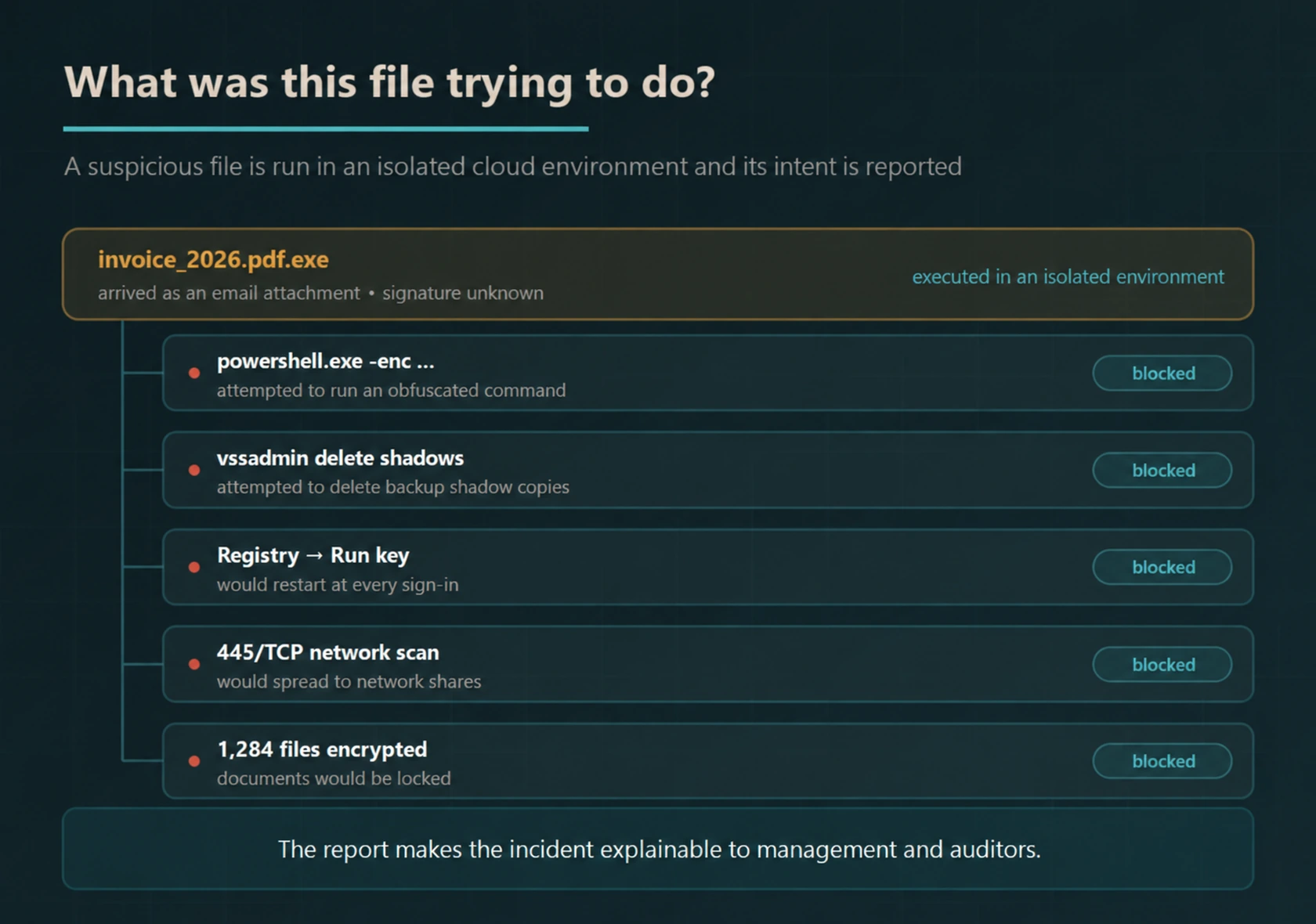
Sample behaviour report: every step planned by the file and the moment that step was blocked.
XDR: Firewall and Antivirus Notify Each Other
XDR (Extended Detection and Response) is an approach that combines signals from different security layers into a single event. EDR sees only the endpoint; XDR, on the other hand, sees both the endpoint and the network.
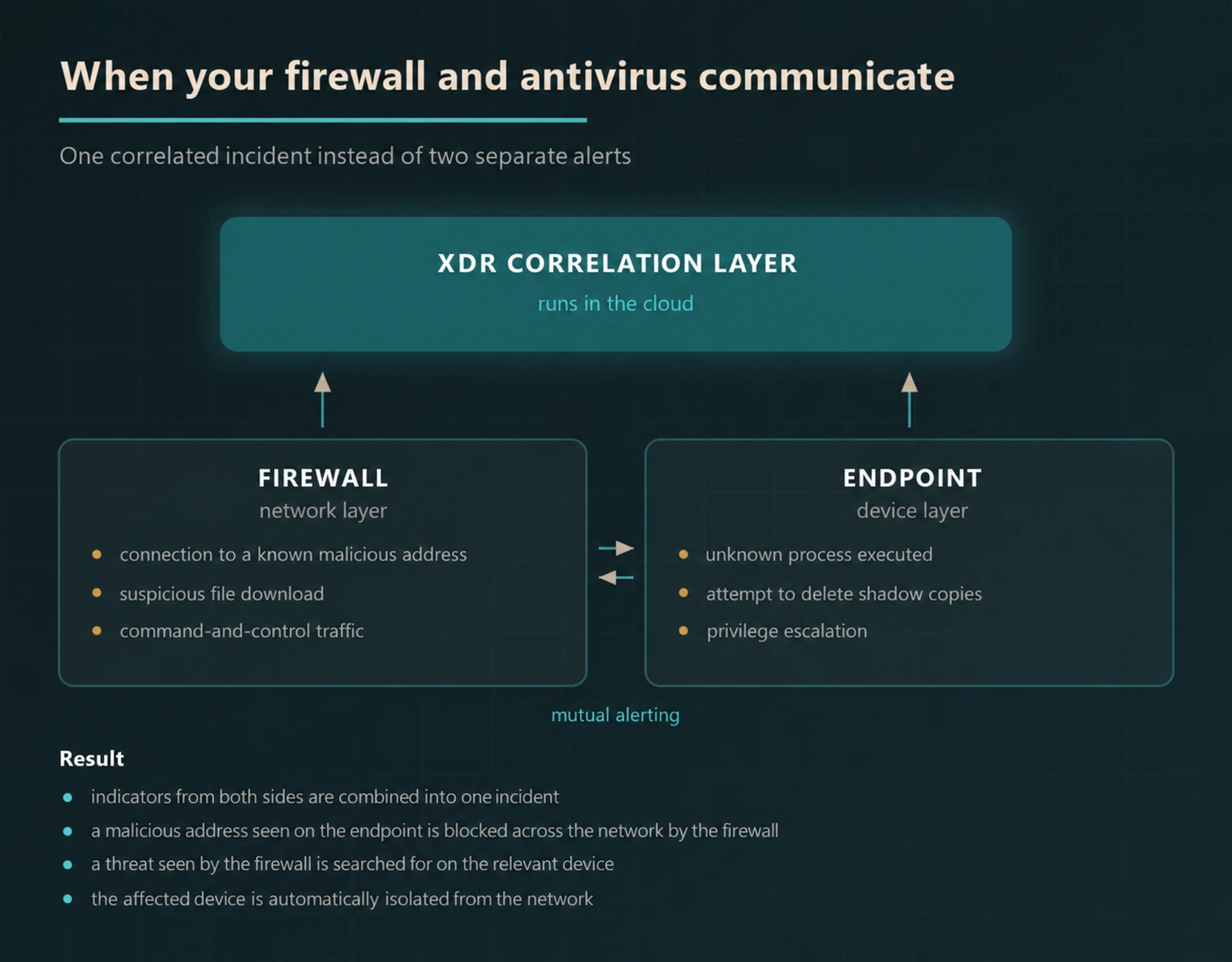
In practice, this means: firewall When you set up endpoint protection from the same vendor, the two systems communicate with each other and generate mutual alerts.
The ecosystem we use WatchGuard within the ecosystem WatchGuard firewall and WatchGuard endpoint protection communicate through the same cloud platform:
- If it is observed that a device on the endpoint connects to a malicious address, that address is blocked in the firewall for the entire network The same threat cannot reach other devices.
- If the firewall catches a threat in network traffic, the endpoint protection on the relevant device searches for the same trace and cleans it if found.
- Traces on both sides are merged under a single event; instead of two separate alerts, a single record is created showing the whole picture.
- If necessary, the affected device is automatically isolated from the network.
This integrated structure is particularly valuable for businesses without a security team: the system performs this correlation itself without needing an expert to combine and interpret alerts from two separate products.
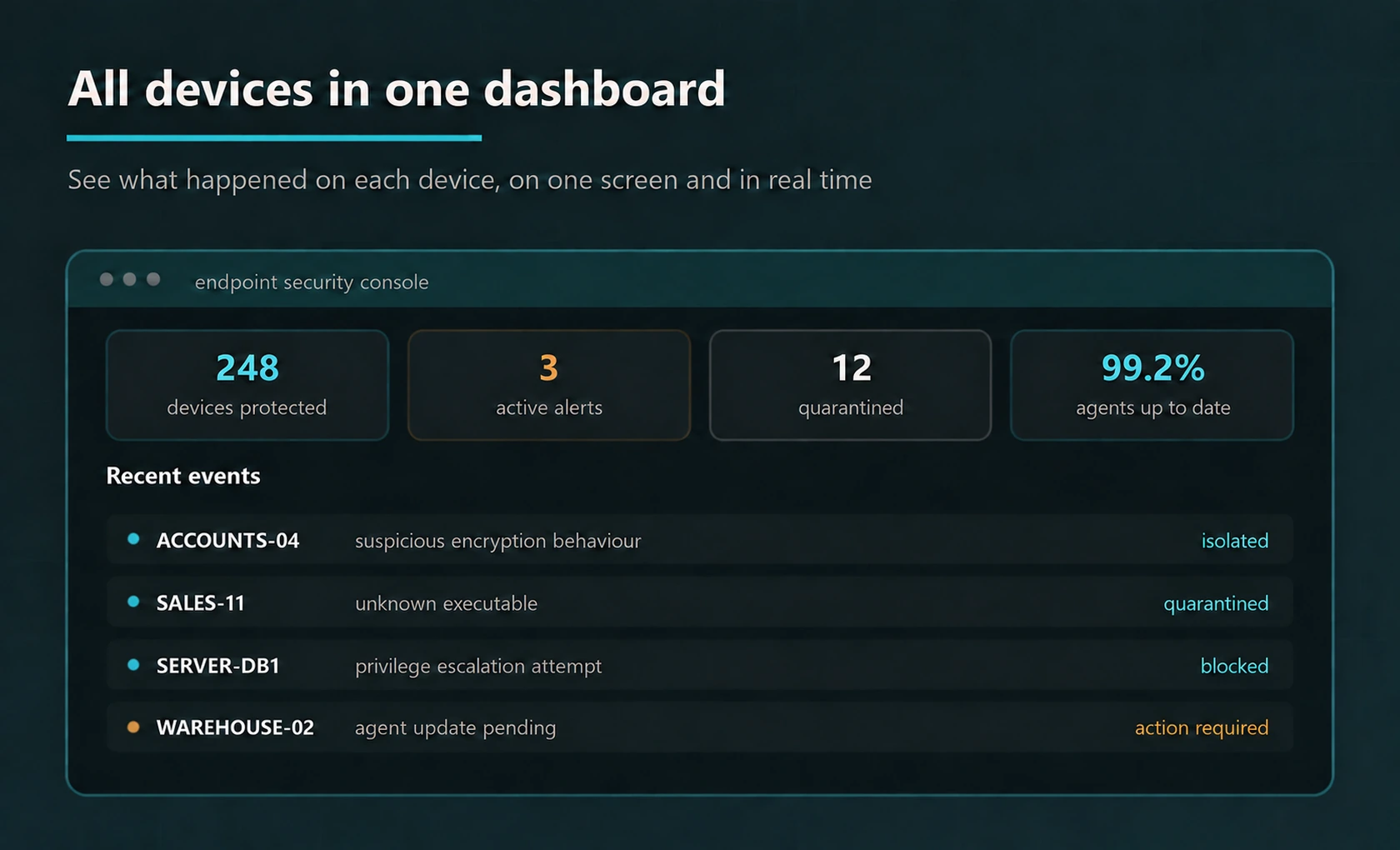
All Devices from a Single Panel
The main difference in enterprise endpoint security is centralised management. You can see from a single screen what is happening on which device, which agent is not up to date, and which event is awaiting intervention.
When suspicious behaviour is observed on a device, that device can be remotely isolated from the network; the spread stops even if you are not in the office at that time.
Regular reports make it possible to explain the organisation’s security status to management.
Scope of Our Endpoint Security Service
- Needs Analysis and Product Selection
An appropriate solution is determined by evaluating the number of devices, operating system distribution, remote working arrangement, and sectoral requirements. - Agent Installation and Deployment
Endpoint agents are deployed centrally; they are installed without disturbing the user and without interrupting working hours. - Behaviour-Based Threat Detection
Encryption, shadow copy deletion, privilege escalation, and lateral movement behaviours are monitored in real-time. - Ransomware Protection and Recovery
Encryption behaviour is stopped; in supported solutions, changes made are reverted and files are recovered. - Fileless Attack Detection
Malicious processes that never write to disk and run only in memory are monitored and detected. - Device and Environment Control
USB usage, external devices, and application execution permissions are restricted by policy.
- Remote Isolation and Response
Suspicious device is removed from the network with one click, malicious process terminated, and spread stopped. - Event Chain Analysis
It is retrospectively tracked where the threat came from, which files it touched, and which devices it reached. - Cloud Simulation and Behaviour Report
Suspicious file is executed in an isolated cloud environment; which commands it will run and how it will damage the system is reported. - Cross-Layer Correlation with XDR
Signals from the firewall and endpoint are combined into a single event; the two systems alert each other. - Central Management Console
All devices, policies, alerts, and quarantine are managed from a single panel. - Update Monitoring
Devices with outdated agents or disabled protection are detected and an alert is generated. - Reporting
Regular security status reports are prepared; they can be used for audit and management presentations. - Continuous Support
Policy updates, incident review, and response support are provided under the maintenance agreement.
Does Antivirus Replace the Firewall?
No. They are different layers and do not replace each other. Firewall monitors network entry; endpoint security monitors what runs on the device.
Malware can reach the device by bypassing network control via a USB drive, personal email account, remote desktop connection, or a laptop brought from home. This is the meaning of a layered security approach: when one layer is bypassed, the other remains active.
Which details are important in an antivirus and EDR proposal?
The presence of artificial intelligence in the product name alone is not a sufficient selection criterion. The operating systems used, server roles, remote working devices, and compatibility with existing security tools should be examined. Not every feature may be available on every platform or licence package.
During the pilot installation, the operation of business applications, resource usage, and management of alerts should be observed. The authority to define exceptions, who will decide on device isolation, and the procedure to follow in case of a false alarm should be clarified.
Compare the offers together with the number of devices, licence duration, and scope of support. Generating an alarm and reviewing and responding to an alarm are different services. Protection against ransomware should be considered along with updates and tested backups; a single security product does not guarantee prevention of all incidents.
Frequently Asked Questions
What is AI-powered antivirus?
AI-powered antivirus is endpoint security software that, instead of only comparing a file to a known list of malicious files, decides based on what the file does when executed. Thanks to machine learning models and behaviour analysis, it can also detect malware that has never been seen before.
What is the difference between traditional antivirus and AI-powered antivirus?
Classic antivirus is signature-based: it compares a file to a list of known malware fingerprints, and if it’s not on the list, it lets it pass. AI-based antivirus, on the other hand, monitors the behaviour of the file; if it sees actions like encrypting a large number of files, deleting shadow copies, or spreading across the network, it stops it even if its signature is completely unknown.
What is EDR, and how is it different from antivirus?
EDR (Endpoint Detection and Response) not only blocks the threat; it records how the incident started, which devices it spread to, and what it changed. It provides response capabilities such as isolating the device from the network, terminating processes, and undoing changes made.
Does it really provide protection against ransomware?
Ransomware does not operate in a single step; it goes through initial access, execution, privilege escalation, lateral movement, and encryption steps. Behaviour-based protection can break this chain in the early stages. Even if encryption has started, some solutions can recover files by undoing the changes.
Is Windows' own antivirus not sufficient?
The protection that comes with the operating system provides a reasonable baseline for individual use. However, enterprise needs are different: centralised management, device-based policies, event logging and retrospective analysis, remote isolation, and reporting from a single console are required. These are the domains of enterprise endpoint security solutions.
Which devices does it work on?
Windows and macOS computers, Windows and Linux servers, virtual desktop environments, and mobile devices can be protected. An appropriate agent is installed according to the device type, and all are managed from the same console.
Does it slow down computers?
Modern endpoint solutions perform most of the analysis on the cloud side and run a lightweight agent on the device. When scan scheduling and exclusion rules are correctly configured, there is no noticeable slowdown in daily use.
What is XDR, and how is it different from EDR?
XDR (Extended Detection and Response) is an approach that combines signals from different security layers into a single incident. EDR only sees the endpoint; XDR, on the other hand, sees the endpoint together with the network. Thus, a trace seen on the firewall and a trace seen on the device are associated as part of the same incident.
Can the firewall and antivirus communicate with each other?
Yes. When the firewall and endpoint protection are deployed from the same vendor, the two systems communicate through the same cloud platform. In the WatchGuard ecosystem we use, a malicious address detected on the endpoint is blocked across the network via the firewall; a threat detected by the firewall in the network is searched for on the relevant device. The traces on both sides are combined under a single incident. For more details firewall .
Can I see what the malware wants to do?
Yes. The suspicious file is run in an isolated cloud environment and its behaviour is recorded step by step: which commands it would execute, whether it would delete backup shadow copies, whether it would modify the registry for persistence, where it would spread on the network, how many files it would encrypt. The resulting report gives the full picture of the incident without anything happening on your real system.
Does antivirus replace the security firewall?
No, they are different layers. The firewall monitors network entry, while endpoint security monitors what runs on the device. Malware can reach the device via USB drive, personal email, or remote desktop, bypassing network control; at this point, the endpoint protection takes over.
Our Complementary Security Services
Endpoint security is part of a layered structure. To protect network entry Business firewall solutions, for legal record obligations 5651 logging solutions, to see the weak points of your current setup penetration testing and to keep a copy of your data safe cloud backup you can evaluate our services together.
Let’s Evaluate Your Current Protection
How many devices do you have, which are up-to-date, are there any devices with protection turned off, can you perform retrospective review in case of an incident? We assess your current situation, recommend a suitable endpoint security solution for your organisation, and also take over its management after installation.
For evaluation you can contact us.