



Custom e-commerce development
Custom e-commerce development is the right route when standard store platforms cannot support your sales process. Cloud Bilişim designs dealer pricing, product rules, order approvals and ERP connections around how your business actually operates.
When does bespoke e-commerce make sense?
Consider bespoke development when a standard store cannot reliably support your pricing, product configuration, approvals or ERP workflows. Compare the full development and maintenance scope before choosing a platform.
Related services and next steps
Business process automation, AI integration for businesses, Contact Cloud Bilişim.
A custom e-commerce system is an online sales platform that we build from the ground up around your sales rules. You are not bound by the limits of a ready-made platform. Instead, you shape the design, integrations, speed and security to suit your project. Therefore, custom e-commerce development is a strong option for brands whose rules do not fit a standard store. When planned well, it helps improve the customer experience and the sales process.
Why Choose a Custom E-Commerce System?
- Designed Around Your Needs
You do not have to fit into the templates of a ready-made platform. Instead, we develop the infrastructure for your business model, operational processes and target audience. - High Performance and Security
The system carries only the code you need. This lean structure makes it easier to tune page speed and security controls to your priorities. - Integration According to Needs
We include ERP, CRM, accounting, shipping, payment and marketplace connections in the project. First, we review the API capabilities and access terms of each service. - Architecture That Can Grow
As your business grows, your system adapts with it. We can add new modules and sales channels without rebuilding the architecture. We also plan server capacity for higher traffic. - User Experience Focused Design
We keep the shopping steps simple. We also arrange the category structure and product pages around user behaviour. The aim is to help visitors reach checkout in fewer steps.
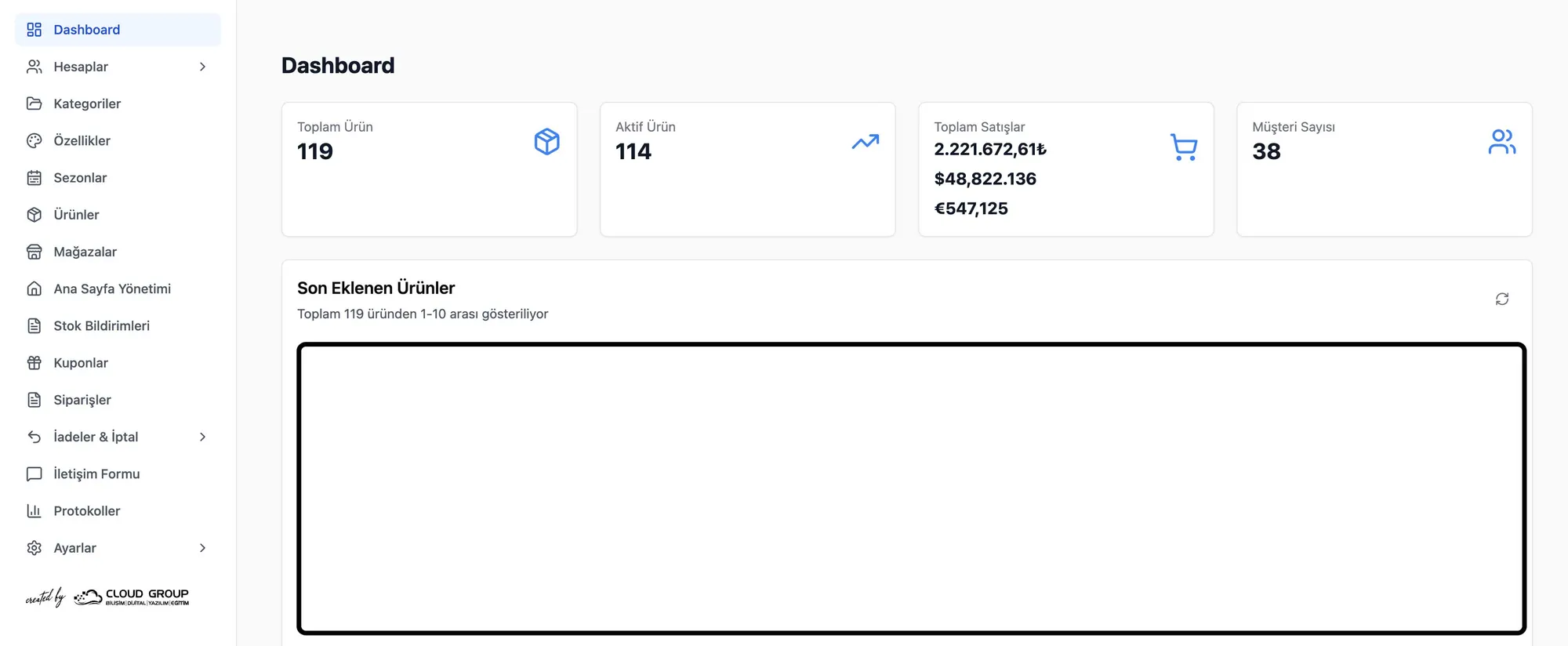
All visuals come from real projects and appear with permission.
What Does a Custom Admin Panel Give You?
A custom admin panel lets you manage your e-commerce operations from one place, securely and in an orderly way. We design its screens around your processes, team structure and workflows. In addition, you do not have to work around menus you never use, as you often do in ready-made panels.
Advantages of the Custom Admin Panel
- Easy-to-Use Interface
A clean interface lets you handle daily tasks in fewer clicks. - Modular Structure
You choose the modules you need. Examples include orders, stock, categories and products, campaigns, shipping integrations and reporting. - Advanced Permission Management
You define separate permissions for each user role. As a result, each team member sees only the screens their work requires. - Real-Time Reporting
You can follow sales data as it comes in. Product performance, best sellers, profitability and customer behaviour reports are typical examples. - Infrastructure Focused on Speed and Security
The panel runs only the code it needs. This shortens loading times and helps reduce security risks.
Why a Custom Admin Panel for You?
- It fits your business processes
- It is faster because it has no unnecessary features
- It follows permission and security rules you define
- It grows with new modules as your business grows
- Provides a professional appearance with a design customised for your brand
How Do We Design the Interface in Custom E-Commerce Development?
We first design the interfaces in Figma, following current UX/UI principles. We plan each screen around user behaviour, workflows and your business needs. As a result, you get a look that is both attractive and easy to use.
After you approve the design, we code the interfaces with current technologies and tune them for performance. Our goal is to deliver a fast, scalable and secure system.
High-Quality UX/UI Experience
We design each step to be user-friendly. Your customers can then use the site more easily and find what they need sooner.
Pixel-Perfect Design
We carry the screens we plan in Figma into development exactly as approved.
Real-Time Preview
You see design changes as they happen and review them with your team.
Flexible and Scalable Structure
We can design new modules, screens or functions later and add them to the system.
- Performance-Focused Coding:
We remove unnecessary code and queries to keep loading times short. - Modern Technologies:
We use current technologies such as React, Next.js and Node.js, depending on the project’s needs. - Server-Side Optimizations:
We prepare the system for heavy traffic with caching, a CDN and a sound data architecture. - SEO Compliant Technical Structure:
Page experience is one of the signals Google considers. For this reason, we aim to support good Core Web Vitals with clean code. However, content relevance remains the deciding factor in rankings.
When should you choose custom e-commerce development?
Do not make the decision solely based on the number of products. You may use dealer-specific prices and payment terms, complex product options or several warehouses. Special approval processes also belong on this list. In that case, assess how you will manage these rules on your current platform in the long run. For a more standard store, you can also compare the WooCommerce e-commerce option.
Before you request a proposal, map one sample order from start to finish. Write down the price calculation, stock allocation, payment result, invoice, shipping handover and return. Integrations should cover not only successful transactions but also timeouts, retries and cancellations.
What determines the price of custom e-commerce development?
In general, sales rules, user roles, product data transfer, number of integrations, and test scope affect the development cost. You should also budget separately for servers, the payment provider and maintenance.
What information do you share in an ERP integration?
First, we decide together during analysis which stock, price, customer, order and invoice fields to transfer. Then we agree on each field’s master data source and sync frequency. We also name who responds when an error occurs.
What should you check when moving from your current store?
Besides product and customer records, review URL redirects, order history and connected services. We recommend that you do not go live until trial migrations and payment tests are complete.
More questions about custom e-commerce development
What is e-commerce software?
E-commerce software lists products, takes orders, processes payments and manages stock. Off-the-shelf packages handle these tasks with standard rules. In custom e-commerce development, however, we code the pricing, stock and approval rules around your business.
Is custom e-commerce better than Shopify or another ready-made platform?
There is no single right answer. For a standard product and price structure, a ready-made platform offers a faster and cheaper start. On the other hand, dealer-specific pricing, complex product options or deep ERP integration usually make custom software the better fit.
How do you build a custom e-commerce site?
The process starts with analysis. First, we write down your sales rules, integrations and a sample order flow together. Then we design the screens in Figma and code them after your approval. Finally, we test payment, stock and return scenarios in a staging environment and plan the go-live.
How do I manage the e-commerce site day to day?
You run daily work from a custom admin panel. We design the order, stock, product, campaign and shipping screens around your processes. Each user role sees only its own screens. As a result, your team manages the store without needing coding skills.
Is a custom e-commerce site secure?
Security depends on the measures you put in place; no system is risk-free on its own. For this reason, we recommend a setup that never stores card data on the site and takes payment on the payment provider’s secure page. In addition, SSL, access controls, up-to-date components and regular backups are the basic measures.