


Custom website development
Cloud Bilişim develops bespoke websites for requirements that go beyond a standard content management system. Custom workflows, real-time data, integrations and administration panels are planned around your business processes and content needs.
How do you choose between a CMS and bespoke development?
A CMS can suit a content-led site with familiar publishing needs. Bespoke development is worth assessing when the project depends on unusual workflows, complex data or integrations; compare both options against the same acceptance criteria.
How do website approaches compare?
| Approach | Typical requirement | Planning consideration |
|---|---|---|
| WordPress | A content-led website your team can edit. | Theme, plugins, updates and publishing workflow. |
| Bespoke development | Custom business rules or data flows. | Application design, testing and maintenance scope. |
| E-commerce platform | Product sales and order management. | Payments, stock, shipping and invoicing connections. |
Related services and next steps
PHP application development, WordPress website development, Contact Cloud Bilişim.
What Is Custom Website Development?
A custom software website is a website coded from scratch without using a ready-made content management system. Every part of the site — its interface, data structure, and management panel — is written according to the project’s needs.
Bespoke development gives you control over the features and workflows defined in the project scope. A standard content management system can be suitable for familiar publishing needs; custom development is worth considering when integrations or business rules need a different approach.
Every exception attempted to be solved with a plugin turns into a patch that becomes harder to maintain later. At some point, pushing the system becomes more expensive than writing what is correct.
There is no such limit on a custom-coded site. Whatever your business rule is, the interface is built accordingly, the data structure is designed accordingly. But we do not recommend this for every project — for most corporate sites WordPress it is a more correct and economical way.
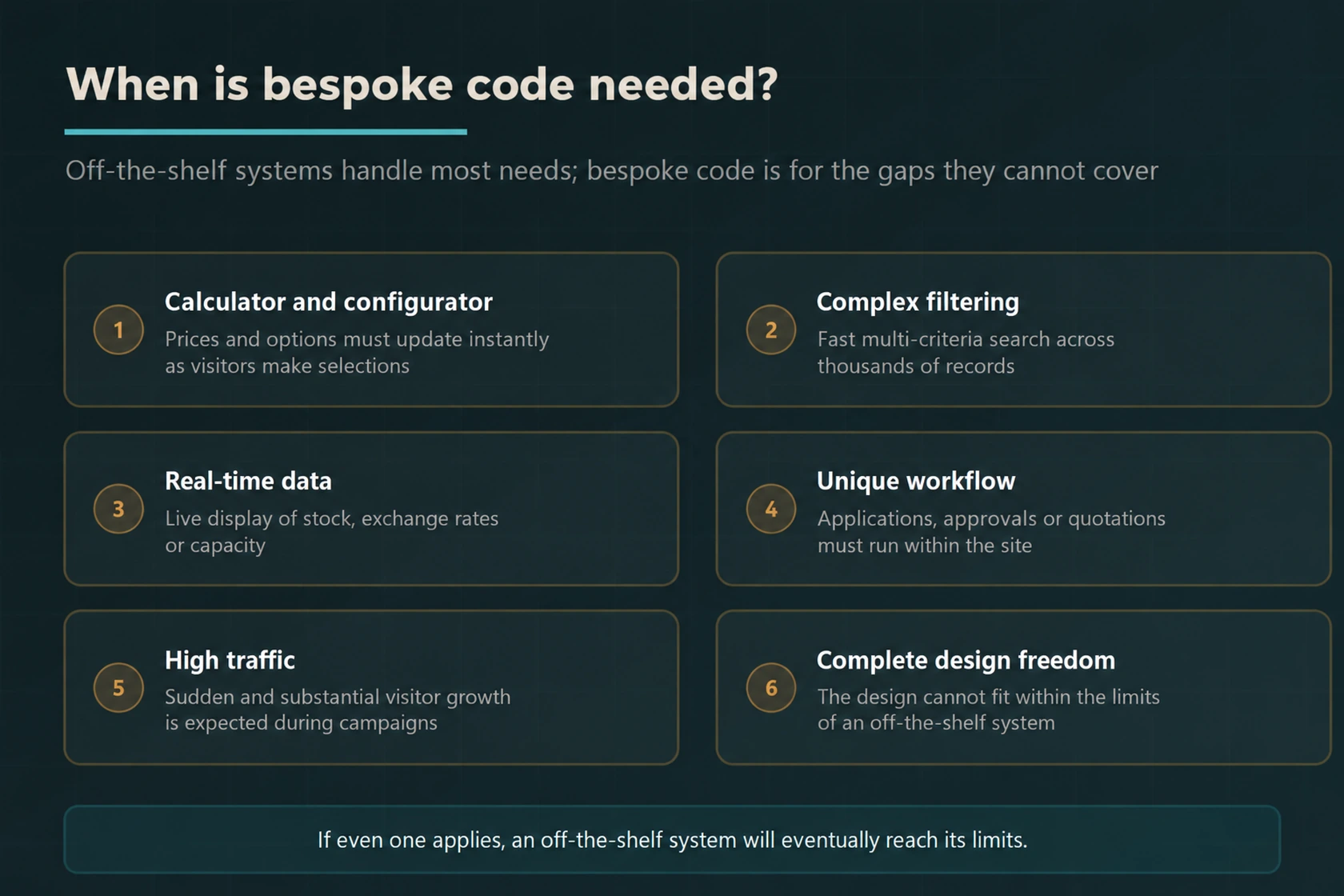
When Is Custom Code Needed?
We answer this question honestly. If none of the following situations apply, a ready-made system will serve your purpose and your budget will not be wasted.
What Does Unlimited Customisation Mean?
In the interface
Design cannot be confined to the sections of a template. Page structure, animations, interactions, and mobile behaviour are all coded according to the design. The sentence “This theme does not support this” disappears.
In Data Structure
Content types and their relationships are defined according to your work. Product, project, dealer, branch, event — whatever concepts you work with, the data model is built on them.
In Business Rules
Price calculation, stock control, approval steps, content that changes according to the user. Every rule for which you would have to look for an add-on in a ready-made system is written directly here.
In Performance
The code for any feature you do not use is not uploaded to the site. The page is fast because it only carries what is needed and can stand more comfortably under heavy traffic.
Who Will Manage the Content?
A custom-coded site does not mean you cannot manage the content. In every project a custom management panel is developed for the site; you update the content yourself.
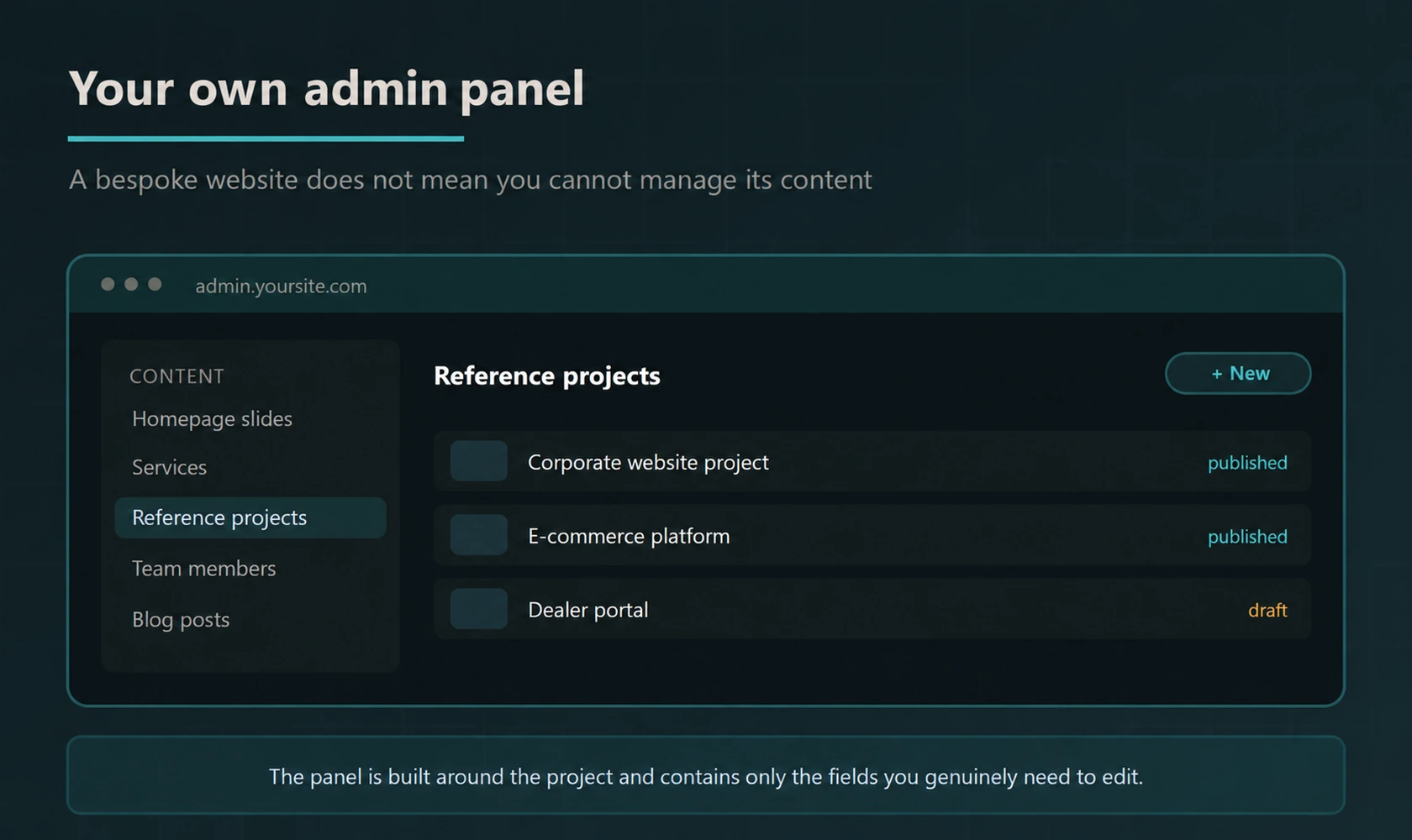
The difference of this panel from the panels of ready-made systems is its simplicity. It does not contain hundreds of settings, menus you do not use, and areas where you could accidentally break the site. Only the areas that are actually editable are included: which text, which image, which list.
Technologies We Use
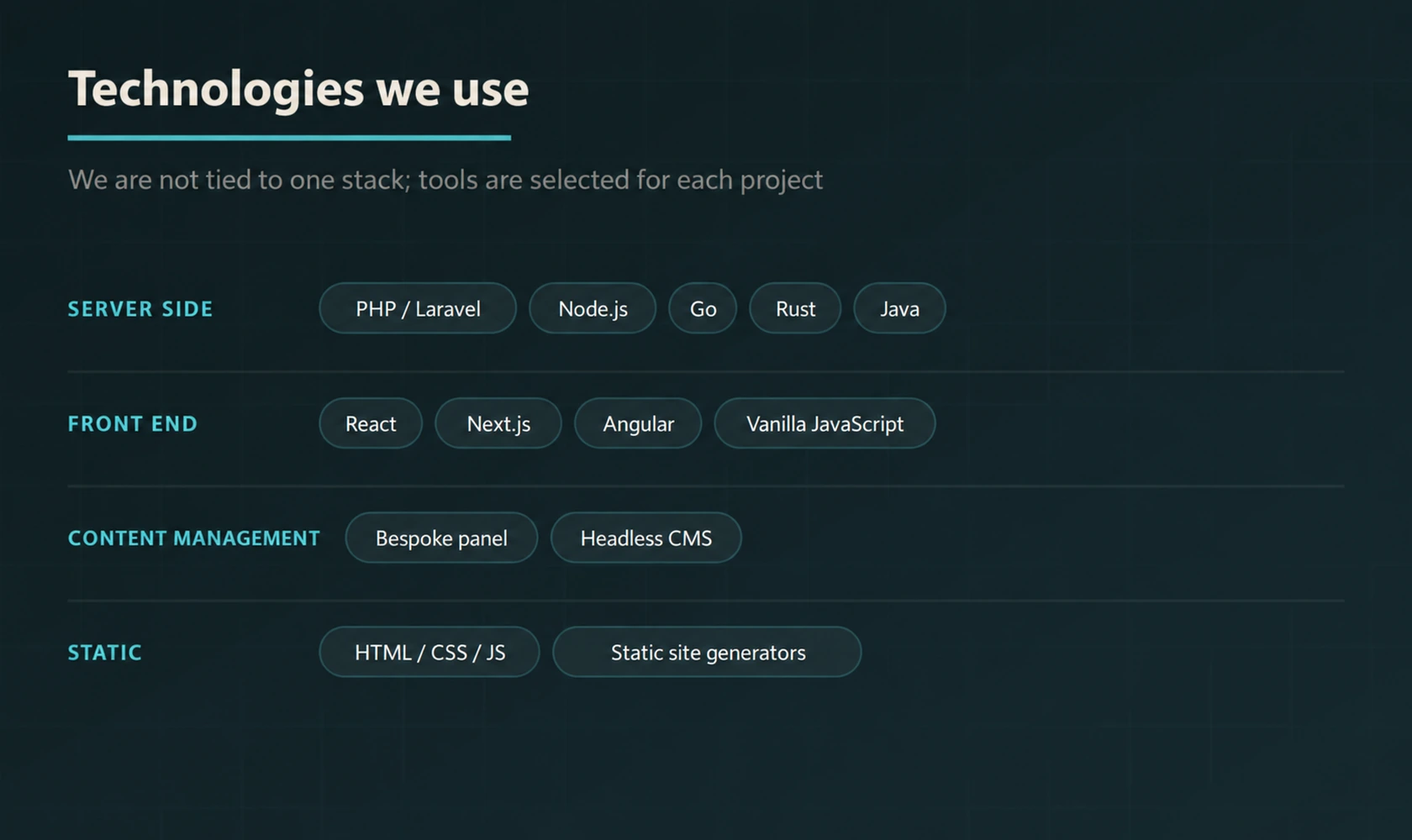
We are not tied to a single technology stack. On the server side PHP and Laravel, Node.js, Go, Rust or Java; on the frontend React, Next.js, Angular or plain JavaScript. For promotional sites where the content does not change, a static structure is the fastest and safest option.
The choice is determined by the needs of the project: expected traffic, whether there is real-time data, the importance of search engine visibility, and the anticipated lifespan of the site. For details on the PHP side PHP application developmentFor our general approach custom software development .
Scope of Our Service
- Needs Analysis
It is evaluated together whether a ready-made system is really inadequate; if it is enough, we say it. - Content Architecture and Data Model
The relationships between page structure and content types are designed. - Original Design and Approval
The design is made from scratch and submitted for your approval before proceeding with coding. - Interface Development
The design is converted into code with the selected technology; mobile behaviour is reconstructed. - Admin Panel
A site-specific, simple panel is developed; there are only areas to be edited. - Integrations
Payment, shipping, accounting, CRM, or external data sources are connected to the app.
- Performance Study
Visual optimisation, caching, and load order are arranged; speed targets are measured and verified. - SEO Infrastructure
Address structure, titles and descriptions, sitemap, and structural markup are established. - Security
Access protection, authorisation, form validations, and server hardening are done. - Server Setup
The environment for running the application is prepared, SSL and backup arrangement are set up. - Source Code Delivery
The code and database structure are delivered to you; no technical dependency arises on our side. - Maintenance and Development
Post-release corrections and new requirements are carried out within the scope of the maintenance agreement.
We Do Not Recommend Custom Code for Every Site
We say this at the risk of losing sales: for the majority of corporate promotion sites WordPress it goes live faster and is more economical. Custom code makes sense where the ready-made system hits a wall.
We measure this first in the meeting. If your needs can be met with a ready-made system, we recommend it.
Ready infrastructure or custom software website?
A ready-made content management system may be sufficient for projects that only require a corporate page and regular content publication. If special price calculation, user-specific data, or institution-specific approval steps are needed, the custom development option should be considered.
When choosing a company, talk about how the business rule will be applied rather than screens that look similar. For example, in a price calculation, which inputs will be used, who can change the result, and whether past records will be kept should be determined from the start.
Include source code delivery, installation documents, management panel training, and test scenarios in the proposal scope. Compare server, maintenance, and future change costs along with the initial development fee; custom software is not mandatory or more economical for every project.
Frequently Asked Questions
What is custom software website?
A custom website is developed around the project's interface, data and administration requirements instead of relying entirely on a standard content management system. Its flexibility depends on the agreed scope, budget, technical constraints and ongoing maintenance.
Why custom code instead of WordPress?
Ready-made systems offer a common template and are very good for tasks that fit that template. If real-time calculation, multi-criteria filtering, real-time data, unique approval workflows, or heavy traffic is involved, the template is not enough. At this point, trying to solve it with plugins becomes more expensive than writing it correctly. If none of these are valid, we recommend WordPress.
Can I update the content myself?
Yes. In every project, we develop a custom management panel for the site. This panel is simpler than the panels of ready-made systems: instead of hundreds of settings and menus you don’t use, it only includes the areas that really need to be edited. There is no place where you could accidentally break the site.
Which technologies do you use?
On the server side, we use PHP and Laravel, Node.js, Go, Rust or Java; on the frontend, we use React, Next.js, Angular, or plain JavaScript. We write a site-specific panel for content management, and in appropriate projects, we also use headless CMS. For static promotional sites whose content does not change, a static setup is preferred. The choice is determined by expected traffic, data structure, and the project’s lifespan.
Is a custom-coded site faster?
Yes, when written correctly. Ready-made systems carry the code of features you won’t use in order to fit every customer. In a custom-coded site, a page only loads what is needed; this reflects on both the loading time and the resilience under heavy traffic.
Are we given the source code?
Yes. The source code and database structure are delivered. The site’s operation does not depend on us; if you wish, you can continue with another team.
Is a custom-coded site more expensive?
Generally yes, because the infrastructure and panel resolved in ready-made systems are also written from scratch. On the other hand, searching for plugins for every exception, keeping those plugins up to date, and dealing with a structure that becomes unmaintainable over time is also a cost. The right decision is made by considering the project’s lifespan.
How does it differ from the website design page?
Website Design explains the design process and is technology-independent; the same process applies to every project. This page, on the other hand, is about which infrastructure the site will be implemented with. The design is done uniquely, the thing that changes is the structure built on top of it.
Our Relevant Services
For the design process website designFor a more economical alternative WordPress websiteFor the PHP side PHP application developmentFor our general approach custom software development, if you are going to make sales custom software e-commerce systems And for the infrastructure where the site will run cloud server services You can check our pages.
Let’s First See If It’s Really Necessary
Explain what your site needs to do; let’s measure together whether it can be met with an off-the-shelf system. If it can be met, we recommend it; if it cannot, we concretely show what the custom code would solve.
To meet you can contact us.