


Cyber security tailored to your industry
Cloud Bilişim plans cyber security around the data, access needs and business continuity priorities of different industries. For organisations in Türkiye, we identify critical systems and likely disruption scenarios before prioritising technical controls and maintenance.
How are industry security priorities selected?
Start with critical data, access paths and the impact of a service interruption. Review sector obligations and current controls, then prioritise actions by operational risk and the ability to maintain them.
Related services and next steps
Penetration testing services, Business firewall solutions, Contact Cloud Bilişim.
What Does Sector-Based Cybersecurity Mean?
Sector-based cybersecurity is determining the measures to be taken according to the sector in which the business operates. The data each sector protects, the cost of a disruption, and the regulations it is subject to are different; therefore, the same security prescription does not fit every business.
The worst-case scenario for a hospital is the leakage of patient records. For a factory, it is the stoppage of the production line rather than a data leak. The most concrete obligation of a hotel is to keep records of the internet it provides to its guests. All three require cybersecurity, but what each needs to do first is different.
As Cloud Bilişim, instead of suggesting a product, we start by identifying what is the most costly to lose in your industry. The roadmap is built on this identification.
Why Does the Security Need Vary by Sector?
Three axes are decisive. Sensitivity of the data: a patient record is not the same as an inventory list. Cost of interruption: The stoppage of a production line for an hour does not cause the same result as an office being without emails. Regulatory burden: In some sectors, there are additional obligations to KVKK.
When we evaluate these three axes together, it becomes clear where the same budget should be spent.
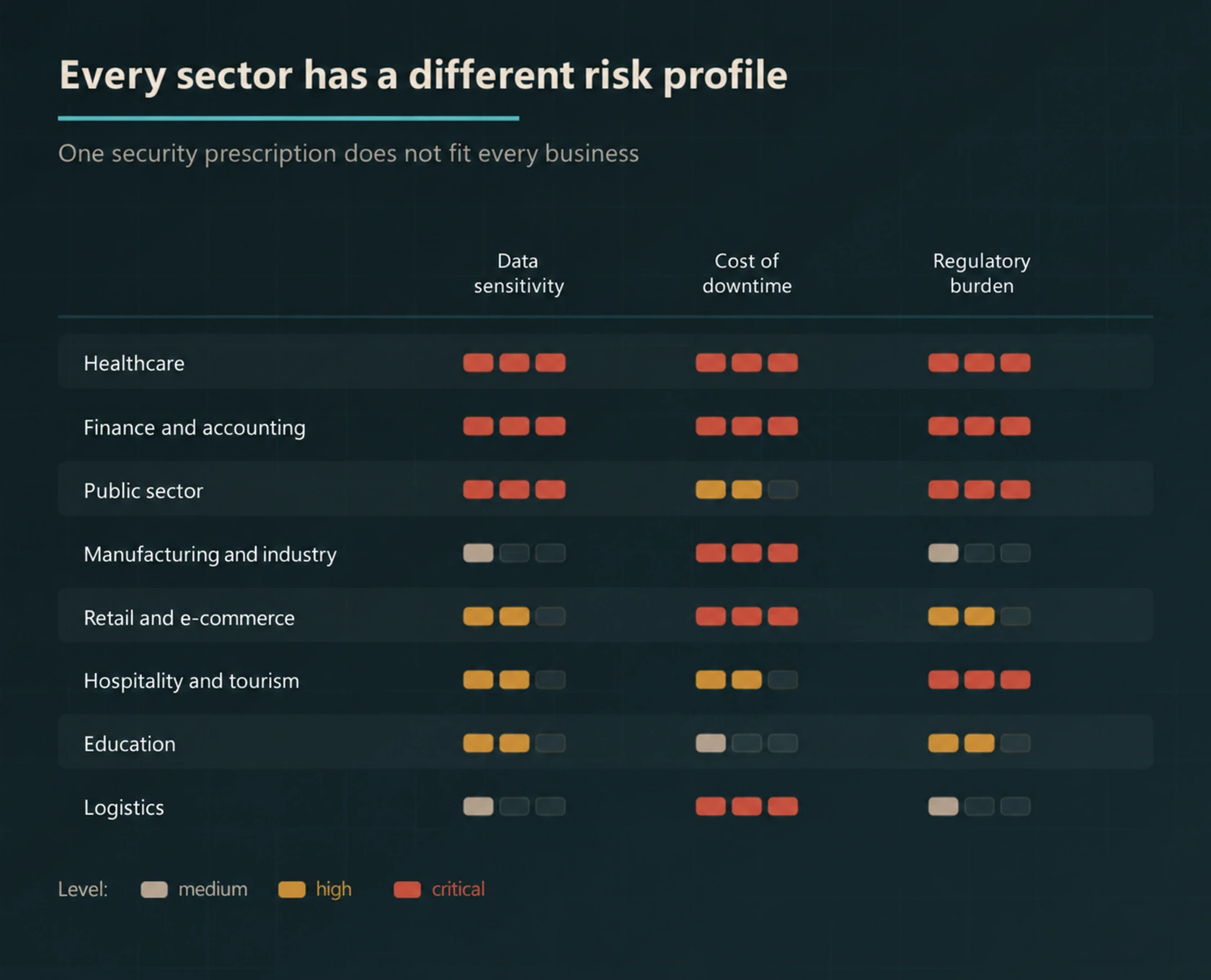
The position of sectors on the three axes determines which heading will take priority in this table.
Risk and Priorities by Sector
| Sector | Most critical risk | Priority measure | Prominent regulation |
|---|---|---|---|
| Health | Leakage of patient data, stoppage of appointment and registration system | Access authorisation, backup and recovery, network isolation of the device | KVKK (sensitive data) |
| Finance and accounting | Financial data leak, fraudulent payment instruction, ransomware | Email security, multi-factor authentication, endpoint protection | KVKK, sectoral regulations |
| Public sector | Leak of citizen data, service interruption | Logging and traceability, authority management, penetration testing | KVKK, Information and Communication Security Guide |
| Production and industry | Production line stoppage, takeover of machines with legacy systems | Separation of the production network from the office network, redundant access (HA) | KVKK (personnel data) |
| Retail and e-commerce | Payment and customer data, outage during peak season | Payment infrastructure security, guest network separation, uninterrupted access | KVKK, payment security standards |
| Accommodation and tourism | Non-retention of guest records, transition from guest network to the internal system | Guest network logging, guest/staff separation, capacity planning | Law No. 5651, KVKK |
| Training | Student data, misuse of open campus network | Content filtering, authenticated access, network segmentation | Law No. 5651, KVKK |
| Logistics | Interruption of the shipment and tracking system, security of field devices | Uninterrupted access, field device management, backup | KVKK |
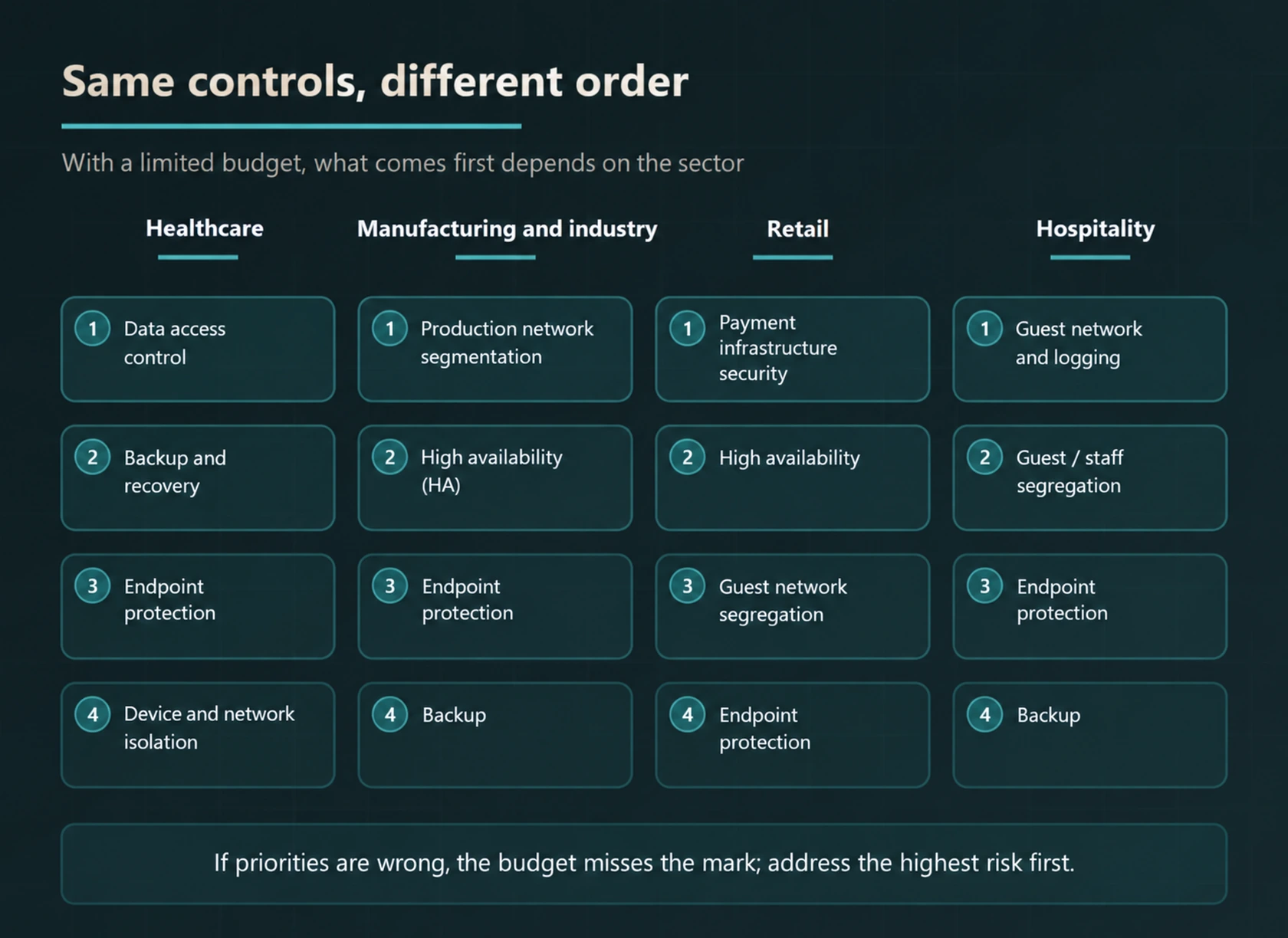
Same Precautions, Different Order
Industries often use the same pool of precautions: network segmentation, endpoint protection, backup, access authorisation, logging. The difference is in which order they are carried out. If the budget is limited, this order directly determines the return on the money spent.
How Do We Work?
- Current Status Analysis
The network structure, device inventory, backup status, access permissions, and security products used are examined on site. - Sectoral Risk Assessment
Your company’s risk profile is determined in terms of data sensitivity, downtime cost, and regulatory burden. - Prioritised Roadmap
Which step will be taken first is prioritised according to budget and impact; the rationale for each step is provided in writing.
- Implementation and Installation
Network separation, firewall, endpoint protection, logging, and backup steps are implemented in the planned order. - Verification
It is tested whether the implemented structure functions as expected; if necessary, it is verified externally with a penetration test. - Continuous Monitoring and Maintenance
The system is monitored under the maintenance agreement, rules are updated, and new risks are added to the roadmap.
I’m a Small Business, Are So Many Precautions Necessary?
Not all are necessary at the same time. The name of our approach is prioritisation: starting with the measure that addresses the highest risk based on your industry’s risk profile, the remaining steps are written into a timeline-based roadmap.
In a small business, most of the time, the first three steps — proper backup, network segmentation, and endpoint protection — cover a large portion of the risk. The rest can be spread over time.
How to choose the security service suitable for your industry?
The same device list does not reduce the risk of each institution to the same extent. Systems sensitive to production interruptions, sensitive records in healthcare, different user groups in education, or branch connections in retail create separate priorities.
Before making an offer, list the assets to be protected, critical business workflows, and access permissions. Ask which risk the proposed solution addresses with which control, and how business processes will be protected during implementation.
Delivery criteria should not consist only of device installation. Verifiable steps such as controlling unauthorised access boundaries, attempts to restore from backup, and responsible personnel in case of an incident should be defined. Technical security work should be carried out together with regulatory assessment, corporate policies, and employee awareness.
Frequently Asked Questions
What does sector-based cybersecurity mean?
Sector-based cybersecurity is determining the measures to be taken according to the sector in which the business operates. Each sector protects different types of data, the cost of a disruption, and is subject to different regulations; therefore, the same security prescription does not fit every business.
Why does the need for security change according to the sector?
Three axes are decisive. The first is the sensitivity of the protected data: a patient record is not the same as an inventory list. The second is the cost of a disruption: one hour of production line downtime does not have the same consequence as an office being without email. The third is the regulatory burden: some sectors have additional obligations in addition to KVKK.
What is the priority in the healthcare sector?
Health data is considered special category personal data under KVKK and requires stricter protection. First comes the authorisation of who can access which record, followed by ensuring backup and recovery times. Separating the network where medical devices are located from the administrative network is also a critical step.
What is the priority in the production and industrial sector?
In production, the main risk is more about downtime than data leakage. Separating the production network (OT) from the office network is the first step. Then comes a redundant structure for uninterrupted access, protection of production panels and devices in the field. Machines running on old operating systems require a separate approach.
What is the priority in retail and e-commerce?
The security of the payment infrastructure and uninterrupted operation during peak seasons are priorities. Separating the in-store guest network from the cash register and stock systems, maintaining a structure that can withstand increased traffic during campaign periods, and protecting customer data are the main points.
What is the priority in the accommodation and tourism sector?
The internet provided to guests directly places this sector under the scope of 5651. Keeping accurate records of the guest network, isolating guest and staff networks from each other, and capacity planning to withstand seasonal peak loads are priorities. For more details 5651 logging solutions and hotspot solutions You can check our pages.
I am a small business, are all these measures necessary?
Not all are necessary at the same time. Our approach is prioritisation: starting with the measure that addresses the highest risk according to your industry’s risk profile, the remaining steps are linked to a roadmap. If the sequence is set incorrectly, the budget does not go to the right place.
How do you start?
We start with a current state analysis: network structure, device inventory, backup status, access permissions, and existing security products are examined. Then, according to your industry’s risk profile, a prioritised roadmap is created, implemented, and the system is continuously monitored.
Services Included in the Roadmap
According to your industry’s risk profile, our following services come into play in different orders: for network entry control Business firewall solutions, for the device side AI-based antivirus programs, for legal record obligations 5651 logging solutions, for open area and guest networks hotspot solutions, for external verification of the existing structure penetration testing and for keeping a copy of the data secure cloud backup.
Industry-Specific Assessment
No matter what industry you are in, the first step is the same: extracting the current situation. We review your network structure, backup status, and access permissions, and prepare a prioritised roadmap according to your industry’s risk profile.
For industry-specific assessment you can contact us.