


Business firewall solutions
Cloud Bilişim supplies and configures business firewall solutions for organisations in Türkiye. We assess internet traffic, branch connections, VPN access, security policies and licences, then define the installation and ongoing management scope.
What determines the right firewall capacity?
Compare user numbers, concurrent sessions, VPN traffic and internet bandwidth with security inspection enabled. Include the required subscriptions and management scope; headline throughput alone does not describe the intended deployment.
What should a firewall comparison include?
| Requirement | Compare | Why it matters |
|---|---|---|
| Inspected traffic | Throughput with the intended security features enabled. | Capacity changes with the inspection workload. |
| Remote and branch access | VPN users, sites and authentication requirements. | Connections must match how staff and branches work. |
| Operations | Subscriptions, monitoring and management responsibilities. | Purchase price alone does not cover the service scope. |
Related services and next steps
5651 logging and KVKK-aware data handling, AI-powered antivirus and endpoint security, Contact Cloud Bilişim.
The First Line of Defence for Your Corporate Network
A firewall is a system that monitors all data traffic between your corporate network and the internet and decides which connections are allowed according to your corporate policies. A properly configured firewall stops unauthorised access attempts from outside before they reach your network and makes the outgoing traffic controllable by recording it.
Today’s threats can no longer be stopped only at the port and IP level. Malicious software hides within encrypted traffic, ransomware spreads from seemingly trustworthy websites, and attackers target remote access services with weak passwords. Therefore, devices that operate solely on traditional packet filtering logic are not sufficient on their own.
As Cloud Bilişim, we implement firewall solutions suitable for the size of your organisation, number of employees, branch structure, and sectoral requirements; and after installation, we take responsibility for policy management, updates, and monitoring processes.
Our goal is not just to install a device; it is to transform your network into a structure that is continuously monitored, recorded, and compliant with legal regulations.
What is a Next Generation Firewall (NGFW) and UTM?
Next-generation firewall (NGFW) monitors traffic not only based on port and IP address, but also according to which application is being used by which user and with what content. Thus, instead of saying “port 80 is open,” meaningful rules can be written such as “this user can use this application during working hours.”
UTM (Unified Threat Management) is an approach that consolidates security components such as intrusion prevention, antivirus, web filtering, antispam, and VPN on a single device. It both simplifies management and reduces total cost for small and medium-sized enterprises.
What Can You Do with a Firewall?
- You can block unauthorised access attempts from outside
- You can determine which user can access which application
- You can block access to harmful and unsafe websites
- You can connect your branch and remote employees via encrypted VPN tunnels
- You can allocate internet bandwidth according to sections and priorities
- You can record and report all network traffic
Why Next-Generation Firewall?
- It significantly reduces the risk of ransomware and data leakage
- It can also detect threats within encrypted traffic
- It reduces operational load through single-point management
- It provides a basis for legal logging and KVKK compliance processes
- It transfers rule management to individual and department level
- Allows branch and remote access to be managed from a single centre
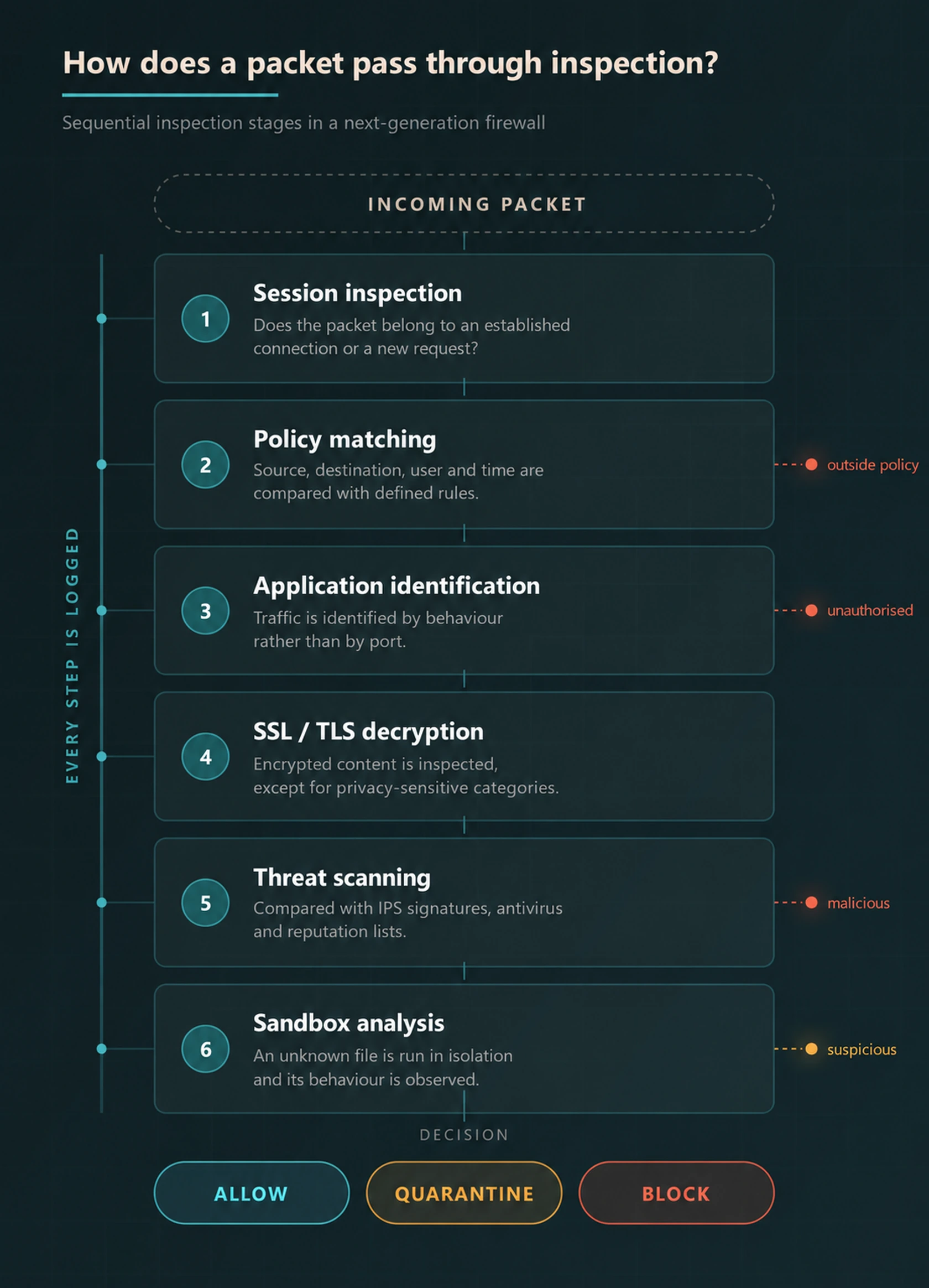
The firewall sequentially subjects every incoming packet to these checks and ultimately decides whether to allow, quarantine, or block it.
Scope of Our Firewall Solutions
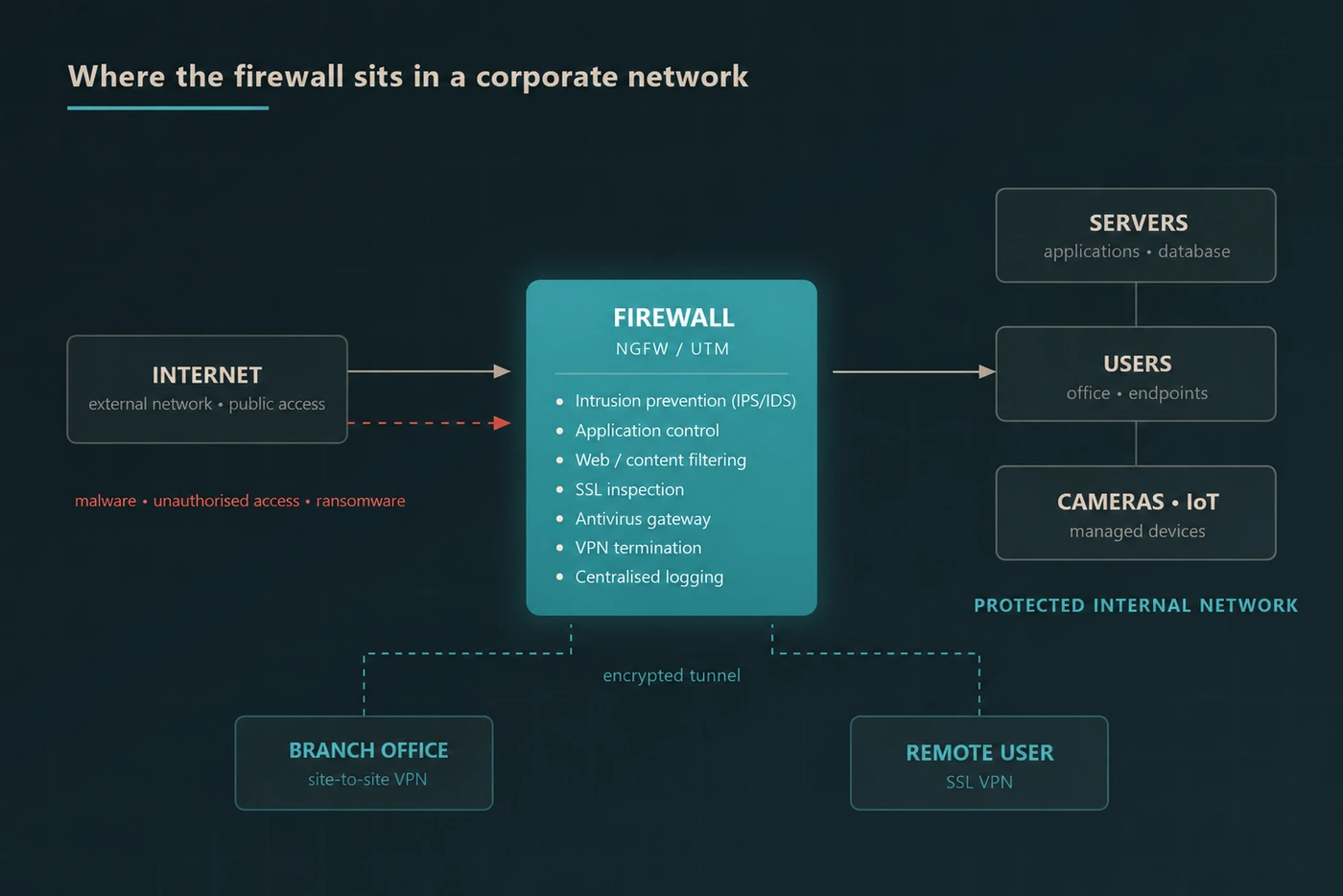
- Intrusion Detection and Prevention (IPS / IDS)
Known attack signatures and abnormal behaviours are monitored in real-time; malicious requests are stopped before reaching your network. - Application Control
It is defined which application can be used by which group and at what times. Applications that reduce productivity and carry risks are restricted. - Web and Content Filtering
Access to sites that distribute malware, are intended for phishing, or do not comply with your organisation’s policy is blocked through category-based filtering. - SSL / TLS Inspection
Encrypted traffic is decrypted in a controlled manner and hidden threats within it are detected; categories requiring privacy are excluded from inspection. - Antivirus and Antispam Gateway
Malicious files and attachments are cleaned at the gateway before reaching the end user, reducing unwanted email traffic. - Sandbox Analysis
Previously unseen suspicious files are executed in an isolated environment and evaluated based on their behaviour.
- Site-to-Site and SSL VPN
Your branches are connected to the central office through an encrypted tunnel; remote workers securely access corporate resources. - Bandwidth Management
Critical applications are prioritised, and high-bandwidth-consuming traffic is limited to balance internet performance. - SD-WAN and Multi-Line Management
Multiple internet lines are used together; in case of a line failure, traffic is automatically redirected to the backup line. - High Availability (HA)
In setups where two devices operate redundantly, network access continues uninterrupted even if one device goes down. - Centralised Logging and Reporting
All traffic is recorded, and with regular reports, it becomes visible what is happening on your network. - User-Based Policy Management
Rules are defined based on individuals and departments instead of devices or IPs; management becomes easier when personnel change.
Legal Logging and KVKK Compliance
Under the law numbered 5651, institutions providing internet access must store traffic records for a certain period and ensure the integrity of these records. The firewall forms the foundation for the accurate and complete production of these records.
We structure the setups we establish 5651 logging solutions together with, solving the security and legal compliance aspects in one go.
When the Firewall and Antivirus Alert Each Other
The firewall network sees the endpoint protection device. When these two layers operate separately, two different parts of the same attack remain as two separate alerts, and no one establishes the connection between them.
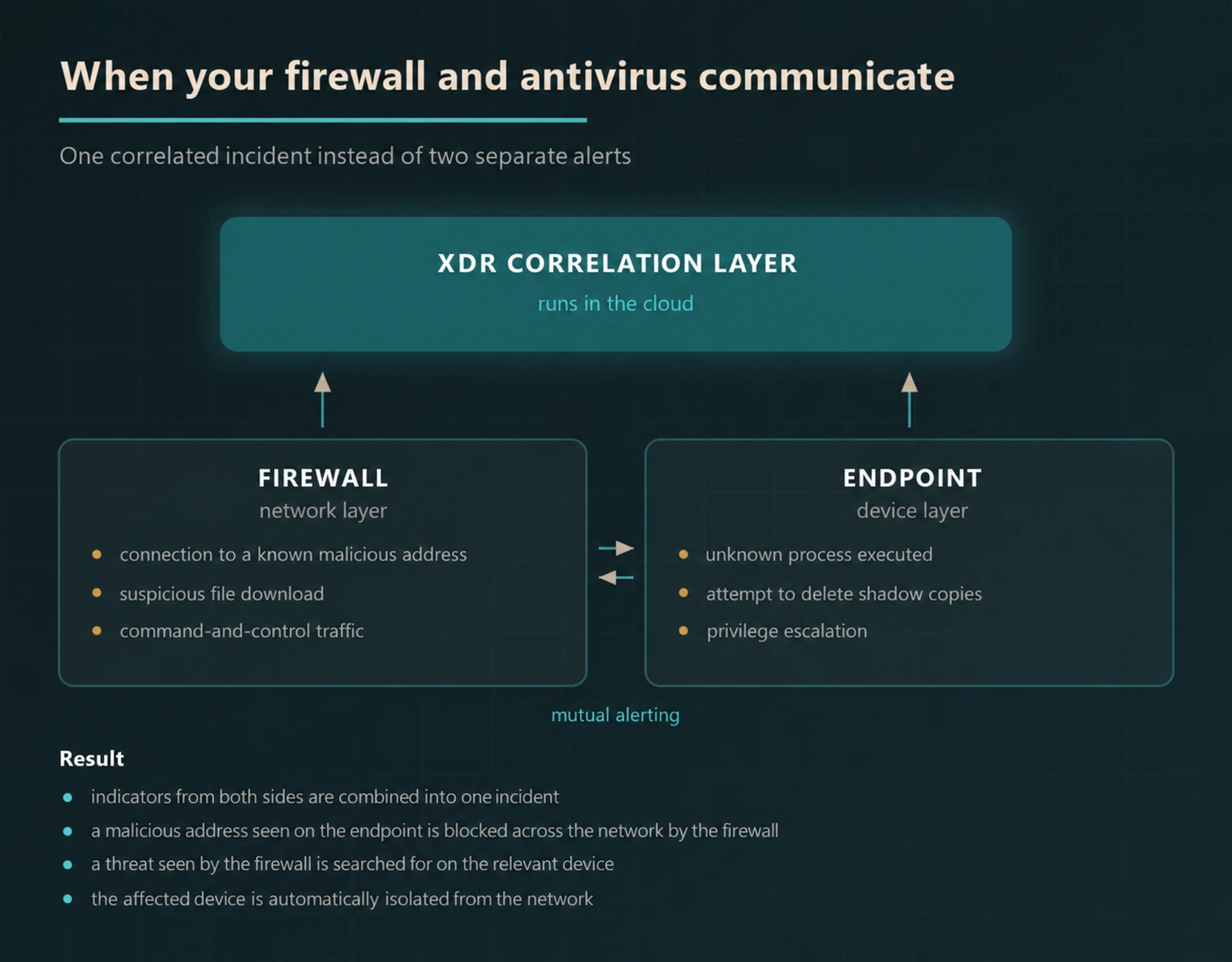
The ecosystem we use WatchGuard communicates the firewall and endpoint protection through the same cloud platform and XDR (Extended Detection and Response) approach combines the signals coming from the two layers into a single incident:
- If a device connects to a malicious address, that address is blocked on the firewall for the entire network .
- If the firewall detects a threat in network traffic, the endpoint protection on the relevant device searches for the same trace.
- The affected device is automatically isolated from the network if necessary, stopping the spread.
For details on the endpoint side AI-based antivirus programs .
How to compare capacity and licences when buying a firewall?
Looking at the device’s maximum connection speed alone is not sufficient. The expected traffic, concurrent users, and VPN connections should be evaluated together while security features are active. The number of branches and growth plan also affect the choice.
See hardware, security subscriptions, installation, rule configuration, and support items separately in the offer. Ask which functions will be affected when the licence expires; if a redundant setup is desired, inquire about the requirements for a second device and licence.
Access rules at delivery, administrator privileges, configuration backup, and VPN tests must be recorded. The scope of monitoring services and incident response times must also be defined. A firewall, endpoint security, and backup are not standalone protections.
Frequently Asked Questions
What is a firewall?
A firewall is a system that controls data traffic between the corporate network and the internet and decides which connections are allowed according to corporate policies. It stops unauthorised access attempts from reaching the network from outside and also records outgoing traffic from inside.
What is the difference between a next-generation firewall (NGFW) and a traditional firewall?
A classic firewall controls traffic based on port and IP address. A next-generation firewall, however, also sees which application is being used by which user and with what content. Thus, instead of opening ports, meaningful rules can be written based on users and applications.
What is UTM?
UTM (Unified Threat Management) is an approach that brings together security components such as intrusion prevention, antivirus, web filtering, antispam, and VPN on a single device. It simplifies management in small and medium-sized enterprises and reduces total cost.
Is the modem's firewall not sufficient?
The firewall on modems generally performs basic packet filtering. It does not see malware within encrypted traffic, does not allow application-based rule writing, does not update attack signatures, and does not generate logs in the level of detail required for auditing. It is not sufficient for corporate needs.
What is SSL inspection for?
Today, the majority of internet traffic is encrypted and malware can also be carried within this encrypted traffic. SSL inspection allows threats within encrypted traffic to be seen by analysing it in a controlled manner; categories requiring privacy, such as banking and healthcare, can be excluded from inspection.
Is a firewall alone sufficient for 5651 logging obligations?
The firewall forms the basis for producing accurate and complete records, but it alone is not sufficient for legal compliance. Records need to be signed with a timestamp, securely stored for the determined period, and be reportable upon request. For details 5651 logging solutions .
How do we connect our branches to the head office?
Branches connect to the head office via a site-to-site VPN through an encrypted tunnel. Remote employees access organisational resources securely through SSL VPN. Both structures terminate on the firewall and are managed from a single point.
Can the firewall and antivirus communicate with each other?
Yes. When the firewall and endpoint protection are installed from the same manufacturer, the two systems communicate through the same cloud platform. In the WatchGuard ecosystem we use, signals from the two layers are combined into a single event with the XDR approach: a malicious address detected on an endpoint is blocked for the entire network by the firewall, and a threat caught by the firewall is searched for on the relevant device, and the affected device is automatically isolated from the network if necessary. For details AI-based antivirus programs .
If the firewall fails, does the internet get disconnected?
In a high availability (HA) structure, two devices work redundantly; when one goes offline, the other takes over and access continues uninterrupted. Additionally, in setups using multiple internet lines, traffic is automatically transferred to the backup line in case of a line failure.
Our Complementary Security Services
A firewall alone does not eliminate all risks; it is the most important part of a layered security approach. To holistically increase your organisation’s security level, AI-based antivirus programs, penetration testing and industry-specific cybersecurity solutions we recommend that you evaluate our services together.
Installation, Management, and Continuous Monitoring
In firewall projects, we analyse your existing network structure, determine the solution with the capacity suitable for your needs, and deploy the system by performing installation and policy configuration. After installation, within the scope of the maintenance agreement, we monitor updates, update the rules as your needs change, and regularly monitor your network.
To determine the firewall solution suitable for your organisation together you can contact us.