



Network maintenance services
Cloud Bilişim provides network maintenance for business switches, routers, Wi-Fi and connectivity infrastructure. We assess your locations, network inventory and critical connections to agree monitoring, maintenance and support responsibilities.
What belongs in a network maintenance agreement?
List the supported sites and devices, monitoring coverage, maintenance windows and escalation contacts. Distinguish response targets from resolution targets and document any equipment, connection or third-party exclusions.
Related services and next steps
Business software licensing, Managed IT support in Istanbul and Türkiye, Contact Cloud Bilişim.
What is a Network Maintenance Agreement?
Network maintenance agreement is a service that includes the continuous monitoring of an organisation’s network infrastructure — structured cabling, switch, router, wireless network, and internet lines — regular maintenance, and intervention within the contractually defined time in case of a failure.
The network is the most invisible infrastructure of businesses. As long as it works, no one notices its presence; when it stops, everything stops. The accounting program does not open, the cash register does not work, the telephone exchange goes silent, camera recordings do not go through.
There is also this: every problem is first known from the network. When the application opens slowly, when a file is saved late, when the image freezes in a meeting, the first blamed is the internet. Sometimes it is justified, most of the time it is not. But this discussion does not end unless measurement is done.
The network maintenance agreement eliminates this uncertainty: the network is continuously monitored, performance is measured, problems are solved with data, not guessing.
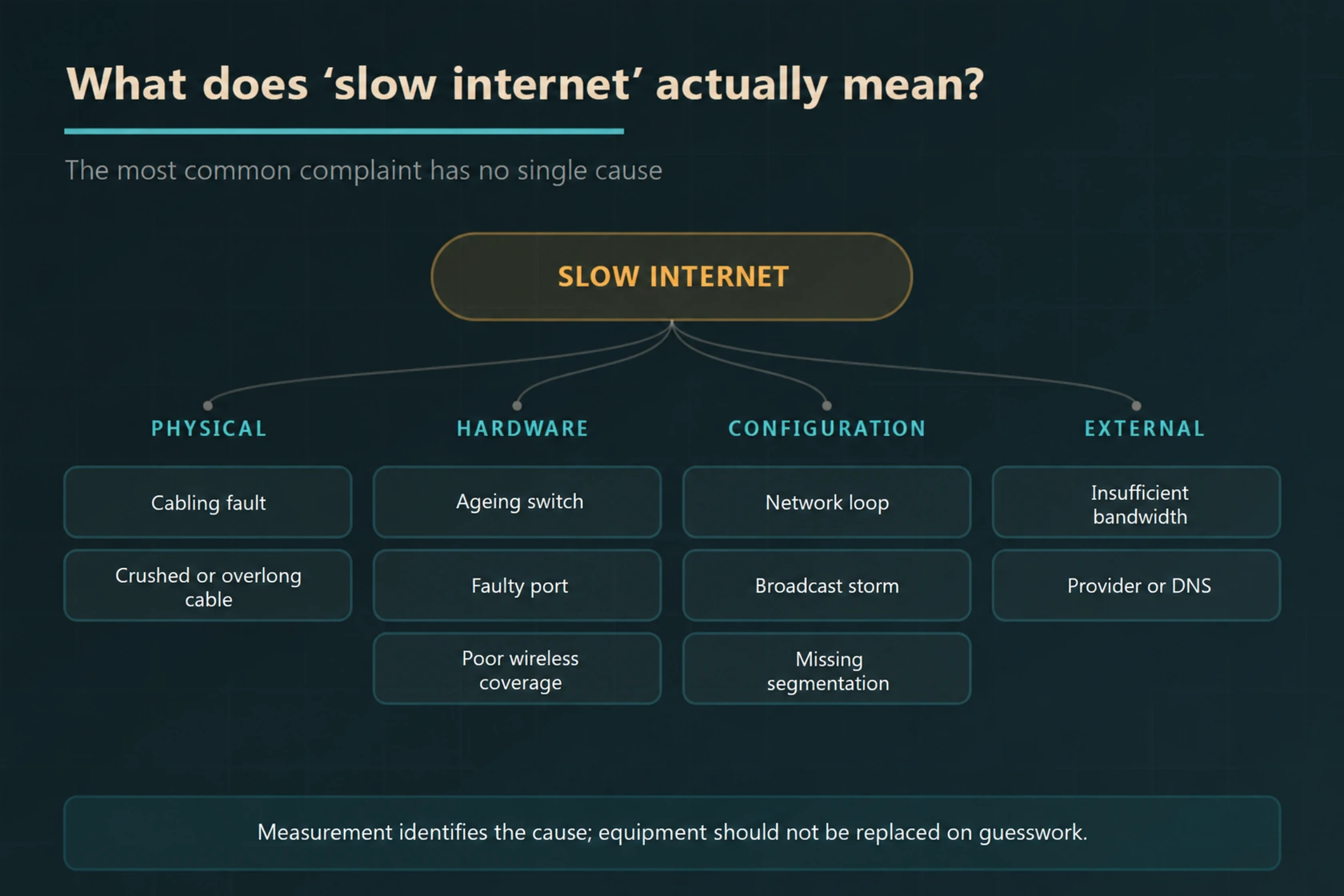
There can be very different reasons behind the same complaint; measurement identifies which one it is.
What is the Difference from the Corporate Maintenance Agreement?
The corporate maintenance agreement covers the entire IT infrastructure: servers, computers, email, printers, and network. The network maintenance agreement, on the other hand, covers only the network layer focuses and goes deeper there: performance measurement, coverage analysis, segmentation, line redundancy, and 24/7 monitoring.
It is preferred as a separate agreement in multi-location, multi-user, or network-intensive businesses. Both can also be purchased together.
Which Layers Does Maintenance Cover?
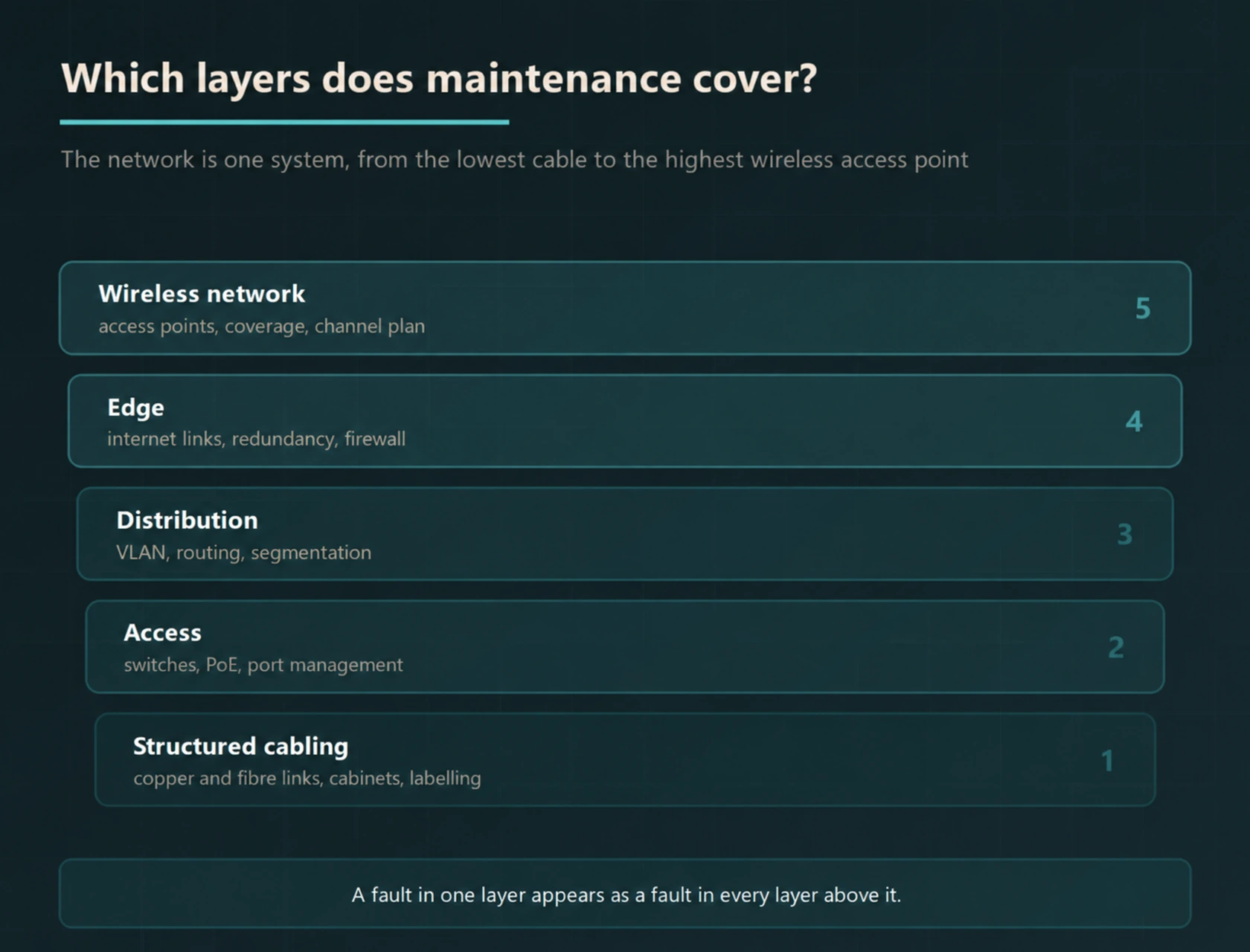
The network is a single entity from the lowest cable to the highest wireless access. A problem in the lower layer appears as a fault in every layer above it — that is why maintenance covers all layers.
Network Monitored 24/7
Network monitoring continuously checks the status of devices and lines and generates an alert before a problem affects the user. A port that frequently goes down and up, a congested line, or a non-responsive access point is noticed before you see it.
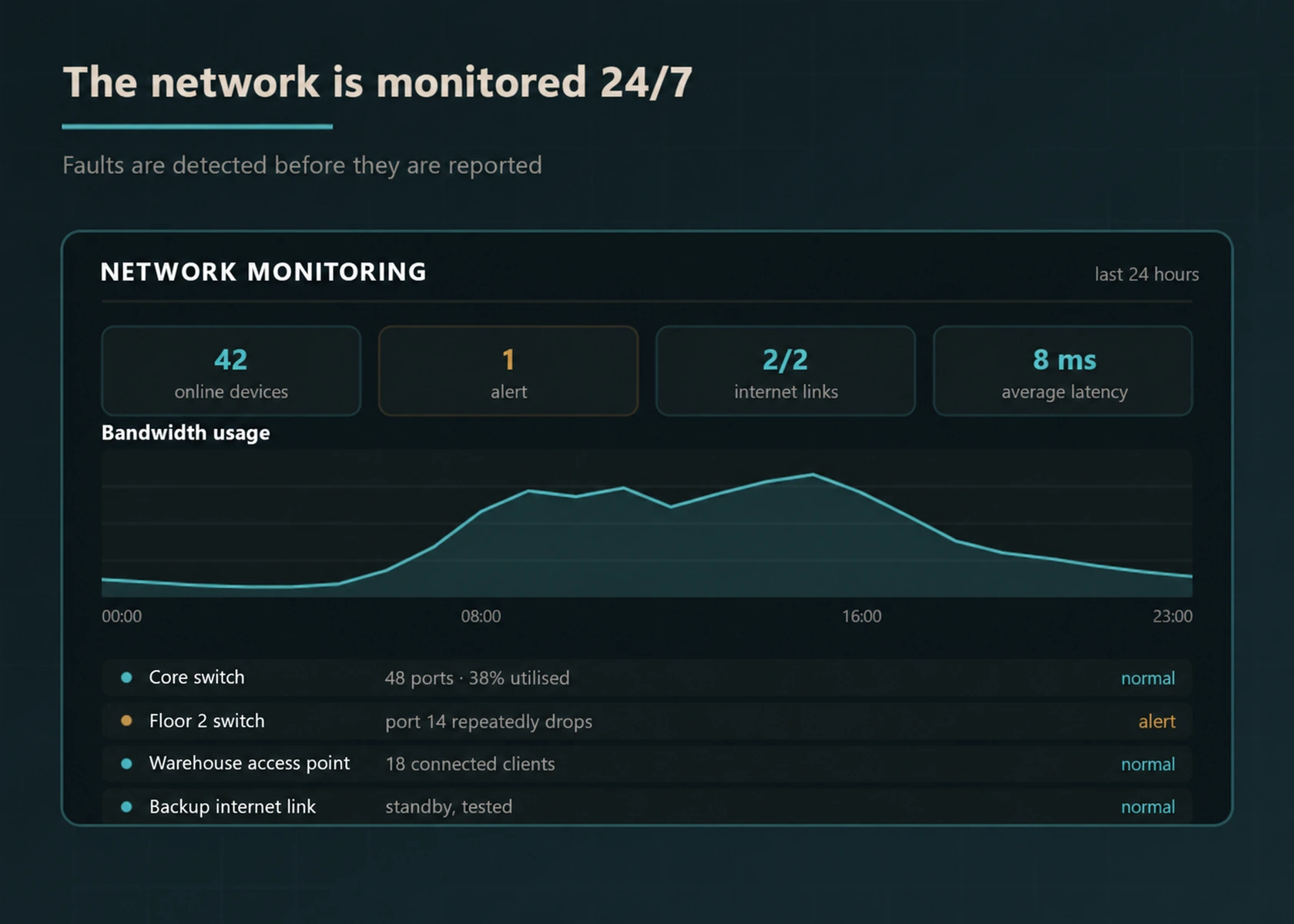
The monitoring panel allows you to see trends instead of waiting for a failure.
Scope of Our Service
- Network Inventory and Topology Extraction
It documents which device is where, which cable goes where, and how traffic flows. - 24/7 Monitoring and Alerts
Device availability, port status, bandwidth, and latency are continuously monitored; an alert is triggered when thresholds are exceeded. - Performance Measurement and Bottleneck Analysis
In case of slow performance complaints, measurement is done instead of prediction; the layer where the bottleneck exists is determined. - Switch and Port Management
Port configurations, VLAN assignments, PoE feeding status, and faulty ports are regularly checked. - Wireless Network Optimisation
A coverage map is produced with field measurement; the access point location, power, and channel plan are arranged. - Network Segmentation
Guest, staff, server, and camera traffic is separated from each other; a problem in one section does not affect the others.
- Internet Line and Redundancy
Line performance is monitored, a second line is configured, and it is regularly tested when activated. - Structured Cabling Maintenance
Panel layout, labeling, loose and damaged lines are checked; tested with a measuring device if necessary. - Configuration Backup
Device configurations are regularly backed up; a new device can be quickly installed in place of a malfunctioning one. - Product Firmware Updates
Updates of switches, routers, and access points are monitored and applied during planned maintenance windows. - Fault Intervention
Configuration issues are resolved remotely; physical failures are addressed on-site. - Monthly Report
Downtime, bandwidth trends, recurring alerts, and capacity recommendations are reported.
Network Documentation: Missing Which is Not Noticed
In most businesses, how the network is set up exists only in the mind of the person who set it up. It is not documented which cable goes where, which port is allocated for what, and which VLAN belongs to which department.
This deficiency does not cause problems while everything is working. But when a failure occurs or that person leaves the job, the first task will be to try to understand the network again — and this adds to the downtime.
As part of the maintenance agreement, topology diagrams, port and cable labeling, and configuration records are prepared and updated with each change.
How is the success of network maintenance service monitored?
To assess complaints of network slowness, a baseline should be recorded. Measurements such as latency, packet loss, connection usage, and wireless coverage help determine whether the problem is on the internet line or in the local network.
Ask about the device scope, configuration backups, firmware updates, and planned maintenance windows in the network maintenance proposal. On-site intervention conditions at multiple locations also become important.
Continuous monitoring does not imply human intervention every hour. It should be specified in the contract who will receive the alert, which incident is considered urgent, and the response target. Preparing a configuration backup and a rollback plan before changes reduces the risk of new outages during fault resolution.
Frequently Asked Questions
What is a network maintenance agreement?
A network maintenance agreement is a service that covers the continuous monitoring, regular maintenance, and contractually defined response times in case of faults for an institution’s network infrastructure — including structured cabling, switches, routers, wireless networks, and internet lines.
What is the difference from a corporate maintenance agreement?
A corporate maintenance agreement covers the entire IT infrastructure: servers, computers, email, printers, and network. A network maintenance agreement, on the other hand, focuses only on the network layer and goes deeper there: performance measurement, coverage analysis, segmentation, line redundancy, and 24/7 monitoring. It is preferred as a separate agreement in multi-location or network-intensive businesses.
Accordion Panel
There is not a single reason for this complaint. It could be a wiring fault, an end-of-life switch, a faulty port, weak wireless coverage, a network loop, a broadcast storm, lack of segmentation, insufficient bandwidth, or a provider-related issue. The correct approach is measurement: traffic, latency, port errors, and wireless signal levels are measured, and intervention is carried out after the cause is found.
What is the purpose of network monitoring?
Network monitoring continuously checks the status of devices and lines and generates an alert before a problem affects the user. A port that keeps going up and down, a full line, or an unresponsive access point is seen and addressed before you even notice.
How are wireless network coverage problems solved?
First, a site survey is conducted: measuring how strong the signal is at each point, which channels are occupied, and whether there is interference with neighboring networks. Based on the results, the number, location, power, and channel plan of the access points are arranged. Most coverage problems are solved with proper positioning and channel planning without buying new devices.
Why is network documentation important?
In most businesses, only the person who set up the network knows how it was built. If it is not documented which cable goes where, what each port is assigned for, and which VLAN belongs to which section, time is lost during every failure. Within the scope of the maintenance agreement, topology diagrams, port and cable labeling, and configuration records are prepared and kept up to date.
Is internet line redundancy necessary?
Internet interruption is necessary for every business where work stops. A second line is taken, preferably from a different provider and with different technology; when the main line goes down, traffic is automatically switched to the backup line. The backup line should be regularly tested to ensure it actually activates.
You did not set up my current network, can I still receive maintenance?
Yes. In this case, work begins with an assessment of the existing structure: device inventory, cabling status, configurations, and topology are documented. At the end of the takeover review, deficiencies and risks are reported, and maintenance continues based on these findings.
Our Relevant Services
Network maintenance gains meaning together with other parts of the infrastructure. For a framework covering the entire infrastructure corporate maintenance agreement services, for monitoring the network entry and line redundancy Business firewall solutions, for guest and open area networks hotspot solutions with 5651 logging solutions,
for protecting data accessed over the network backup and storage solutions You can check our pages.
Let’s Measure Your Network First
How many switches do you have, how many are still supported, where is your wireless coverage weak, is your internet line really sufficient, does your backup line activate? We inventory and map your existing network, measure performance, and report the findings.
For network assessment you can contact us.