


Managed IT support in Istanbul and Türkiye
Cloud Bilişim provides on-site IT support in Istanbul and remote support across Türkiye for businesses with five or more computers. Maintenance agreements cover the systems and responsibilities agreed for your office, factory or branches, including response arrangements and exclusions.
What should an IT support agreement specify?
List the supported users, devices, sites and systems, then agree service hours and escalation contacts. Define response targets, on-site attendance, remote support, maintenance tasks and exclusions separately.
Related services and next steps
Backup and storage solutions, Network maintenance services, Contact Cloud Bilişim.
Let’s determine the scope of maintenance together for on-site service in Istanbul or remote support across Türkiye.
What is a Corporate Maintenance Agreement?
The corporate maintenance agreement, is a continuous service contract that includes the regular monitoring of an enterprise’s IT infrastructure, performing planned maintenance, and intervening within the time frames defined in the contract in case of a malfunction.
In most enterprises, IT support works like this: something breaks, the phone is picked up, an available technician is looked for. Work stops until that technician is found. The problem is solved, everyone is relieved, and until the next malfunction, no one pays attention to the infrastructure.
The cost of this approach does not appear on the invoice; it appears in downtime. A full disk, a backup that hasn’t worked for months, or a server that has reached the end of its life are unnoticed because no one looks, and they reveal themselves at the worst moment.
The maintenance agreement reverses this cycle. Systems are regularly checked, problems are detected before they turn into failures, and when a failure occurs, the intervention time is predetermined.
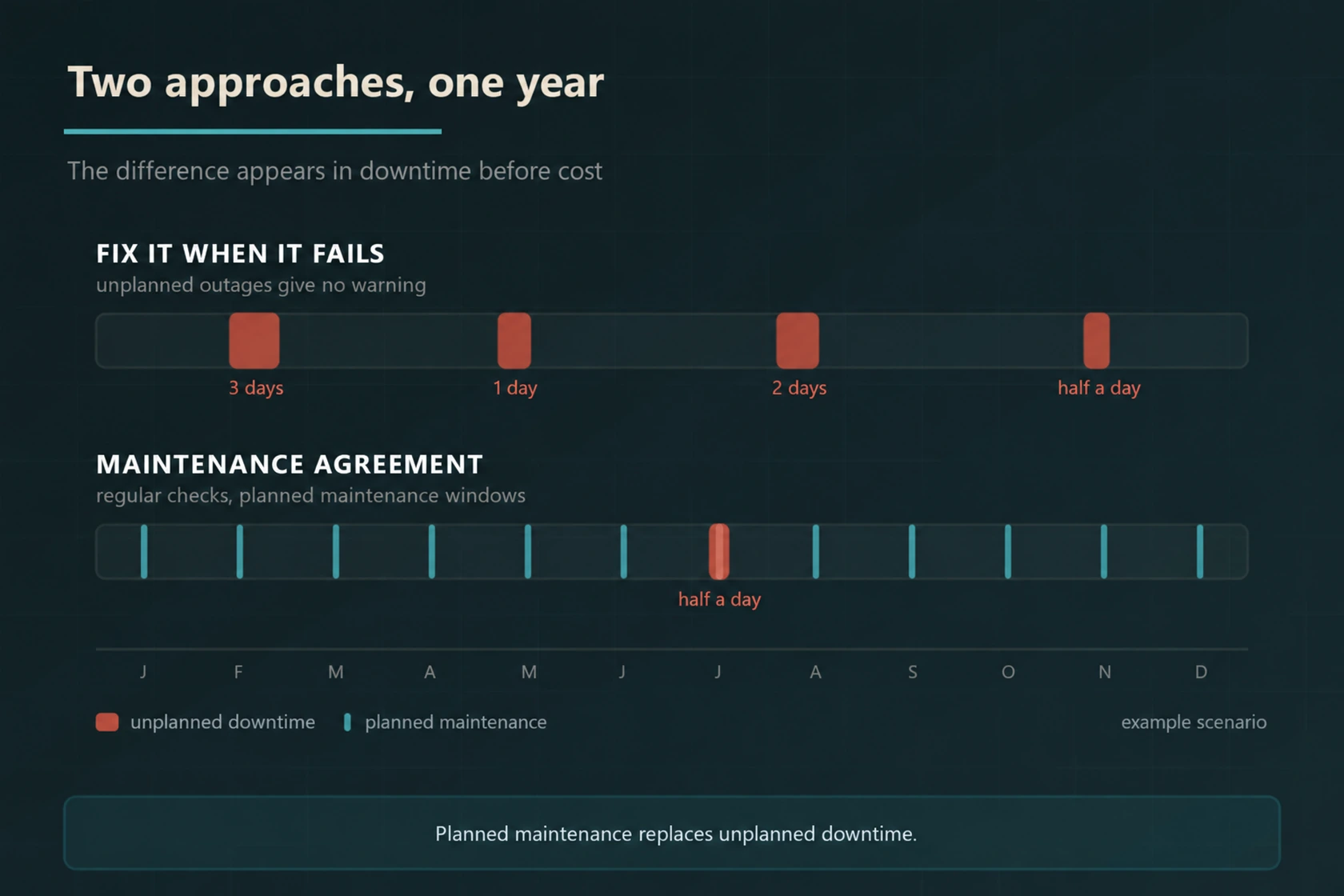
Example scenario: scheduled maintenance replaces unscheduled downtime.
The Difference Between Call-On-Failure and Maintenance Agreement
| Topic | Call on failure | Maintenance agreement |
|---|---|---|
| Response time | When the technician is available | Within the time defined in the contract |
| Cost | Unpredictable, per failure | Defined, budgetable |
| Preventive control | None | Regular, scheduled |
| Infrastructure knowledge | Relearned each time | Inventory and history recorded |
| Backup control | Usually forgotten | Regularly verified |
| Recurring problems | Not noticed | Visible in the report and root cause resolved |
| Responsibility | Unclear | Defined by contract |
What Does the Maintenance Agreement Cover?
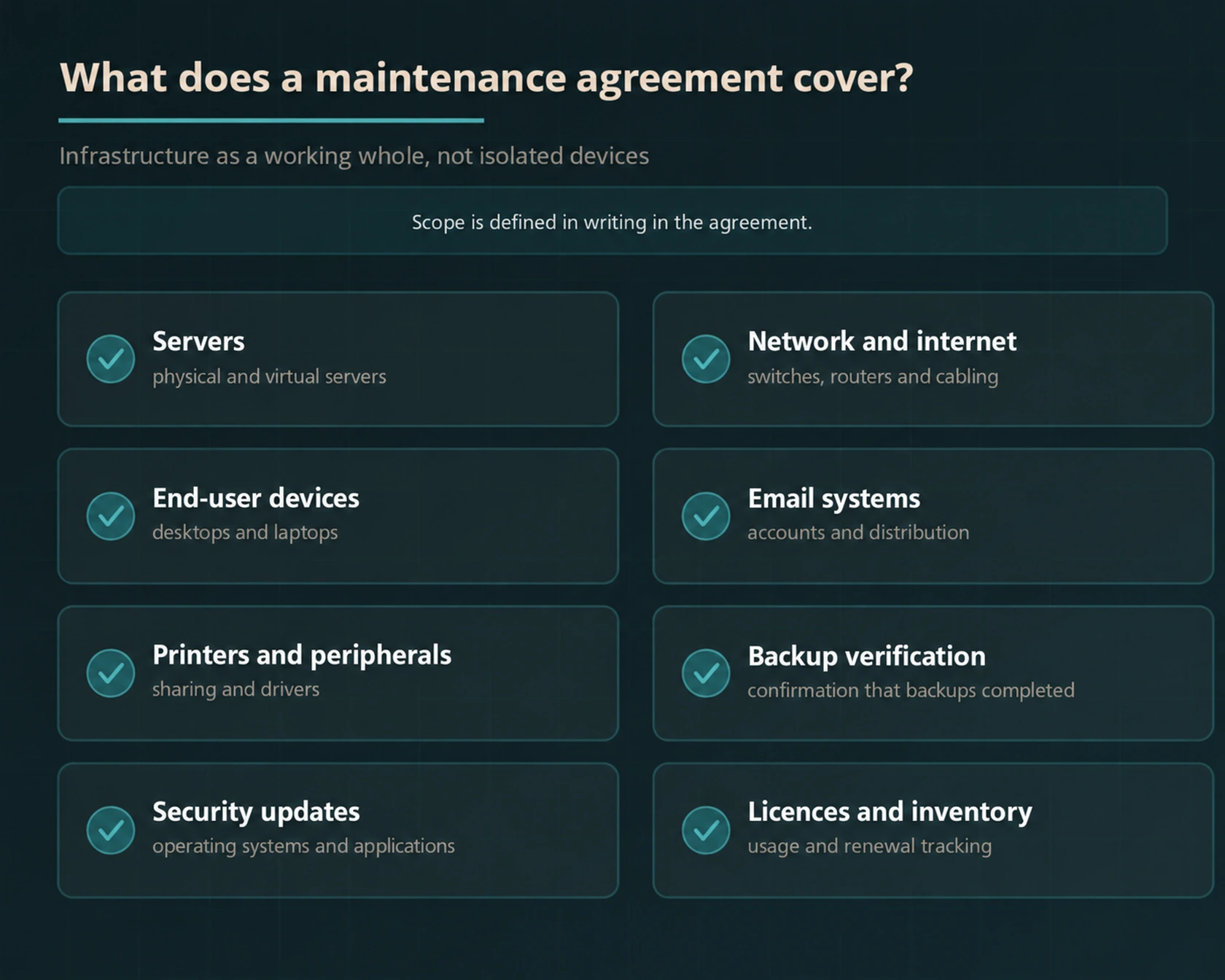
The scope is not individual devices, but the infrastructure as a working whole. It is determined separately for each business and defined in writing in the contract.
SLA: How Long Does It Take to Respond to Each Failure?
SLA (Service Level Agreement) defines how quickly each type of failure will be addressed. Requests are prioritised according to their impact on the business: a failure that stops the entire operation and a problem affecting a single user are not handled in the same order.
| Priority | Meaning | Example | Approach |
|---|---|---|---|
| P1 — Critical | Business operations have stopped | Server crash, internet outage, suspected ransomware | Handled with critical priority according to the emergency support terms in the contract |
| P2 — High | A department or a critical process is affected | The accounting application cannot be accessed, emails are not going | Handled according to the service hours and response targets in the contract |
| P3 — Normal | Only one user affected, alternative way exists | A computer slowing down, printer issue | Planned, resolved when its turn comes |
| P4 — Request | Not a failure, a new request | Opening a new user, installation, moving | Done according to the schedule |
Response and resolution times applicable for each priority level are determined based on your business needs and written numerically in the contract.
How Does a Failure Report Proceed?
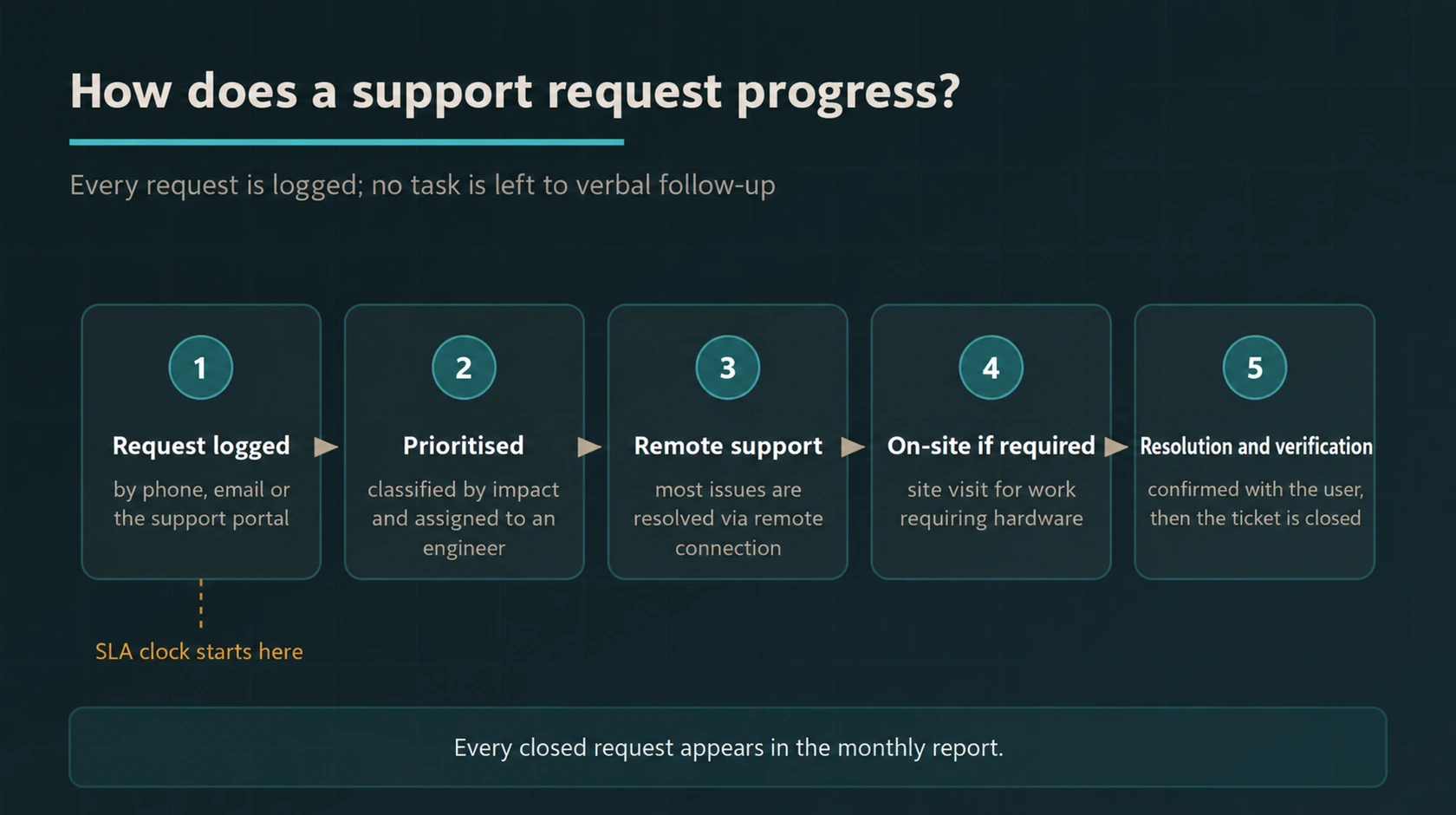
Every request is recorded; no work remains in verbal follow-up.
Scope of Our Service
- Extracting Infrastructure Inventory
The location of each device, the software in use, and when each licence expires are recorded. - Regular Inspection and Planned Maintenance
Server health, disk usage, updates, and system logs are checked at specified intervals. - Remote Support
Software, configuration, and user-related issues are resolved via connection; this is the fastest solution. - On-site Intervention
A field visit is made for tasks that require hardware replacement, cabling, and physical installation. - Backup Verification
Not the backup taken, can be returned to is tested regularly. - Security Updates
Operating system and application updates are monitored and applied during scheduled maintenance windows.
- User Management
Account creation, authorisation, and deactivation processes for incoming and outgoing personnel are carried out regularly. - Licence and Renewal Tracking
Licence expiration dates are monitored, and renewals are reminded before the last day. - Procurement Consulting
For new hardware and software purchases, options suitable to the need and not excessive are recommended. - Root Cause of Recurring Issues
If the same malfunction occurs again, a permanent solution is sought instead of a temporary one. - Monthly Reporting
Opened and closed requests, planned maintenances, backup status, and recommendations are gathered in the report. - Single Point of Contact
There will be a single place to be contacted for all matters related to infrastructure; responsibilities are not scattered.
We Have Our Own IT Team, Is It Still Necessary?
In this case, the agreement does not replace your team, it supports it. It is most frequently used for these four needs: maintaining continuity during leave and vacation periods, second-level support in areas requiring expertise, additional capacity during intense project periods, and regular inspection of the infrastructure from an independent perspective.
The point where internal teams struggle the most is usually that there is no time left for preventive maintenance among daily requests. A maintenance agreement fills this gap.
Response and resolution time in IT maintenance contracts
Responding to a request and completely resolving the problem are different stages. In SLA evaluation, fault priorities, service hours, initial response targets, and situations dependent on third parties should be defined separately.
Alongside remote support, the contract should clearly state on-site visit coverage, included devices, number of users, and the status of new installations. Part replacement, licence procurement, and project-type tasks may be separate from the maintenance fee.
Prepare the device inventory, locations, critical applications, and current issues for the proposal. In the monthly report, in addition to closed requests, ask to see recurring failures, pending risks, and planned maintenance steps. This way, the service is not limited only to interventions when there is a failure.
On-site IT support in Istanbul, remote IT support across Türkiye
We provide on-site IT support to businesses in Istanbul according to the contract scope. For businesses across Türkiye, we provide support for software suitable for remote intervention, configuration, and user issues. Tasks that require physical intervention are not included in the same scope as remote support; the need for on-site service outside Istanbul should be discussed separately.
Support hours and emergency support line for contracted companies
Our standard support service is provided during working hours. We also have a support line that our contracted companies can reach in emergencies. The scope of the emergency request, the intervention method, and the service level are evaluated according to the maintenance agreement. Having an emergency support line does not mean unconditional 24/7 service or a fixed resolution time commitment for all requests.
Which businesses is the maintenance agreement suitable for?
- Offices with 5 or more computers that want to manage user support and regular maintenance from a single point.
- Factories seeking support for office computers, servers, and network infrastructure. The coverage of production machines and special automation systems is evaluated separately.
- Businesses that want to manage user, connection, and access issues in their branches through a common support process.
- Companies that use firewall, local backup, cloud backup, or server and want to define the maintenance of these systems through a contract.
Sample service scenarios according to need
The following are example scenarios that explain how the service can be used; they are not completed customer projects or measured success results.
- An office in Istanbul: Inventory of 5 or more computers is taken; user issues, updates, and on-site interventions when necessary are planned under the contract.
- A factory: Maintenance tasks in office and server infrastructure are scheduled considering the work order; critical systems and responsibility boundaries are determined in advance.
- A multi-branch business: Requests that can be resolved remotely are tracked in a shared process; branch connections and, if necessary, the need for physical intervention are evaluated separately.
- A company using a firewall: Access rules, configuration backups, and update responsibility can be included in the scope of maintenance.
- A company using server or cloud backup: Server checks, failed backup notifications, and the frequency of restoration tests can be defined in the agreement.
Frequently Asked Questions
What is a corporate maintenance agreement?
A corporate maintenance agreement is an ongoing service contract that includes regularly monitoring a company’s IT infrastructure, performing planned maintenance, and intervening within the timeframes defined in the contract in case of a failure. Instead of calling a technician whenever a failure occurs, it aims to prevent most problems before they happen.
Why should I make an agreement instead of calling when a failure occurs?
In the approach where interventions are made only after failures occur, costs are unpredictable and downtime is long; work stops until a technician is found. In a maintenance agreement, systems are regularly checked, issues like full disks and faulty backups are detected before they turn into failures, and the response time is secured by the contract.
What does a maintenance agreement cover?
Servers, network and internet infrastructure, end-user computers, email systems, printers and peripherals, backup control, security updates, as well as licence and inventory tracking are covered. The scope is determined separately for each business and is defined in writing in the contract.
What does SLA mean, how is response time determined?
SLA (Service Level Agreement) defines how quickly a response will be provided for each type of failure. Requests are prioritised based on their impact on work: a failure that stops the entire business is not handled in the same order as an issue affecting a single user. Response and resolution targets for each priority level are stated in the contract.
Is support provided remotely or on-site?
In Istanbul, we provide on-site support according to the contract scope, and remote support across Türkiye. Software suitable for remote intervention, configuration, and user issues are addressed remotely. Tasks that require physical intervention and on-site service outside Istanbul are evaluated separately.
I am a small business, is a maintenance agreement suitable for me?
Our service is aimed at businesses with 5 or more computers. The scope is determined according to the number of users and devices, locations, server, firewall, and backup needs. It can be considered for offices without their own IT team or businesses looking for additional support for their team.
We have our own IT team, do we still need an agreement?
In this case, the agreement does not replace the team; it supports it. It is used for continuity during leave and vacation periods, second-level support on issues requiring expertise, additional capacity in intensive projects, and regular independent inspection of the infrastructure.
What kind of reporting is done?
Every request is recorded and compiled in the monthly report: the number of requests opened and closed, recurring problems, planned maintenance performed, backup status, and recommendations. The report makes it possible to explain the state of the infrastructure to management.
Can we get emergency support outside working hours?
Standard service is during business hours. There is an emergency support line for our contracted companies. The scope of emergencies, intervention method, and service level are evaluated according to the contract; an unconditional 24/7 service commitment is not provided for all requests.
What information is needed for a maintenance agreement proposal?
City, number of locations, number of computers and users, server, firewall and backup infrastructure, and existing issues help determine the scope of the proposal. On-site support needs and working arrangements should also be shared. Service scope and pricing are evaluated based on this information.
Our Relevant Services
A maintenance agreement is a framework that covers the entirety of the infrastructure. For a scope specific to the network side network maintenance agreement services, for the security of your data backup and storage solutions with cloud backup, for software compatibility software licensing solutions, for the security layer Business firewall solutions and AI-based antivirus programs You can check our pages.
Request a managed IT support proposal
How many devices do you have, are your backups really recoverable, which licences are about to expire, which issues recur the most? We inventory your infrastructure and together determine the scope and service level according to the actual needs of your business.
In your request for a quote, specify the number of cities and locations, the number of computers, the servers, firewall, and backup systems you use, and the issue you experience most frequently. Contact us to get an enterprise maintenance agreement offer.