


PHP application development
Cloud Bilişim develops PHP business applications and integration services for organisations in Türkiye. We work with Laravel, Symfony, plain PHP and REST APIs, choosing the approach around the existing codebase, business rules and maintenance requirements.
What is needed to assess an existing PHP application?
Provide the PHP and framework versions, codebase access, hosting details and a list of current issues. The assessment should identify dependencies, test coverage, upgrade constraints and deployment requirements before a change is estimated.
Related services and next steps
WordPress website development, Custom WordPress plugin development, Contact Cloud Bilişim.
What is PHP Application Development?
PHP application development It is writing business applications that run through a browser and do not require installation using the PHP language. The user goes to an address, logs in with a username, and does their work; programs are not installed on every computer, and updates are performed from a single point.
The reason we prefer PHP is not habit, it is the most mature ecosystem for such business. being. It works in almost every hosting environment, server cost is low, finding a developer is easy, and with mature frameworks, code can be maintained years later.
The tasks we describe on this page are needs that ready-made software does not meet. If a product sold on the market works for you, it is more appropriate to buy it; we also say this explicitly. Custom development, is meaningful when your business rules do not fit into the ready-made product.
Which Technology, When?
PHP is not a single thing. Different tools are chosen according to the project’s size, lifespan, and the structure of the team.
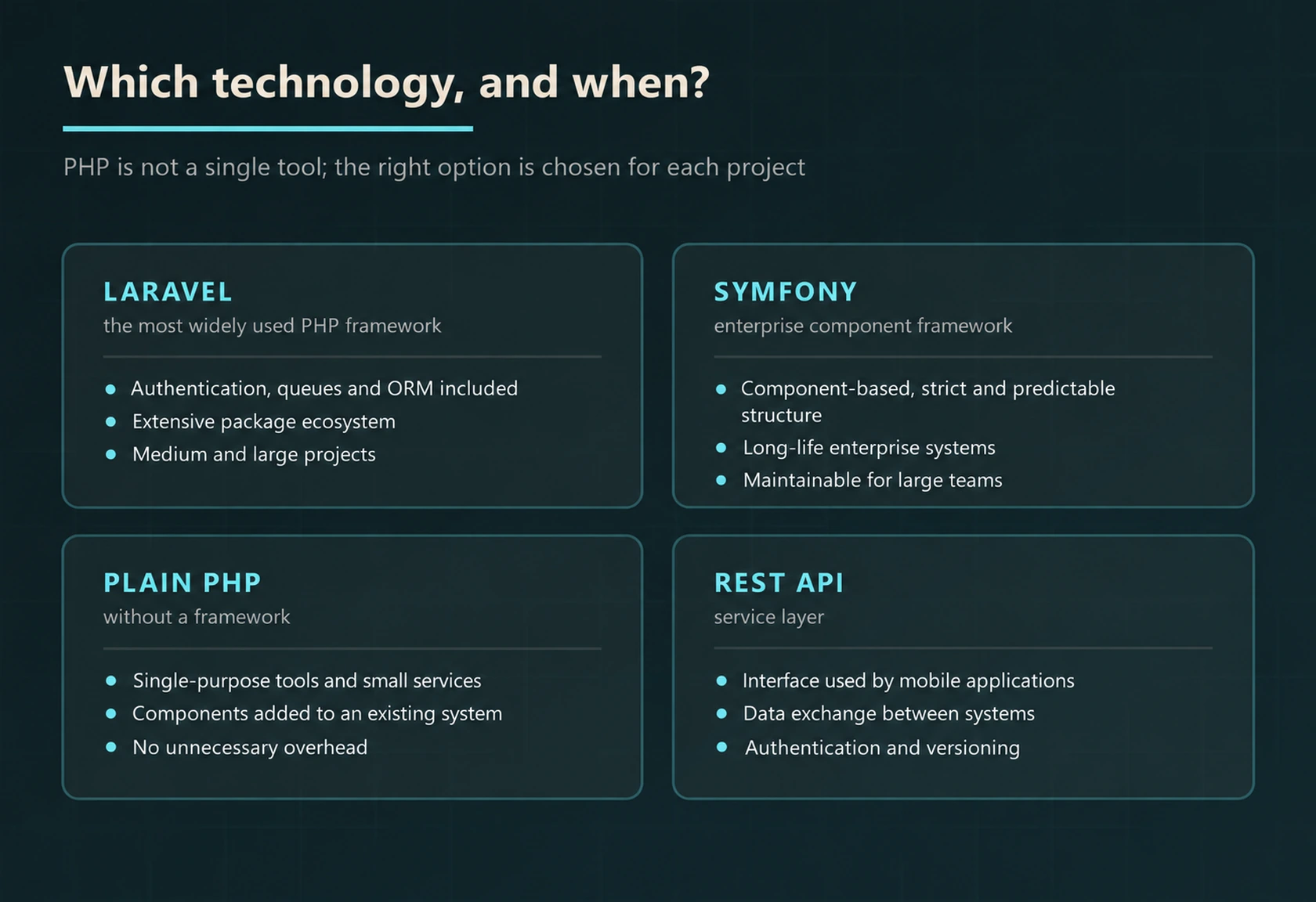
Installing Laravel for a small internal tool brings unnecessary overhead; writing a large and long-lived corporate system without a framework will become unmaintainable in a few years. Making the right choice from the start determines the following years of the project.
What Are We Developing?
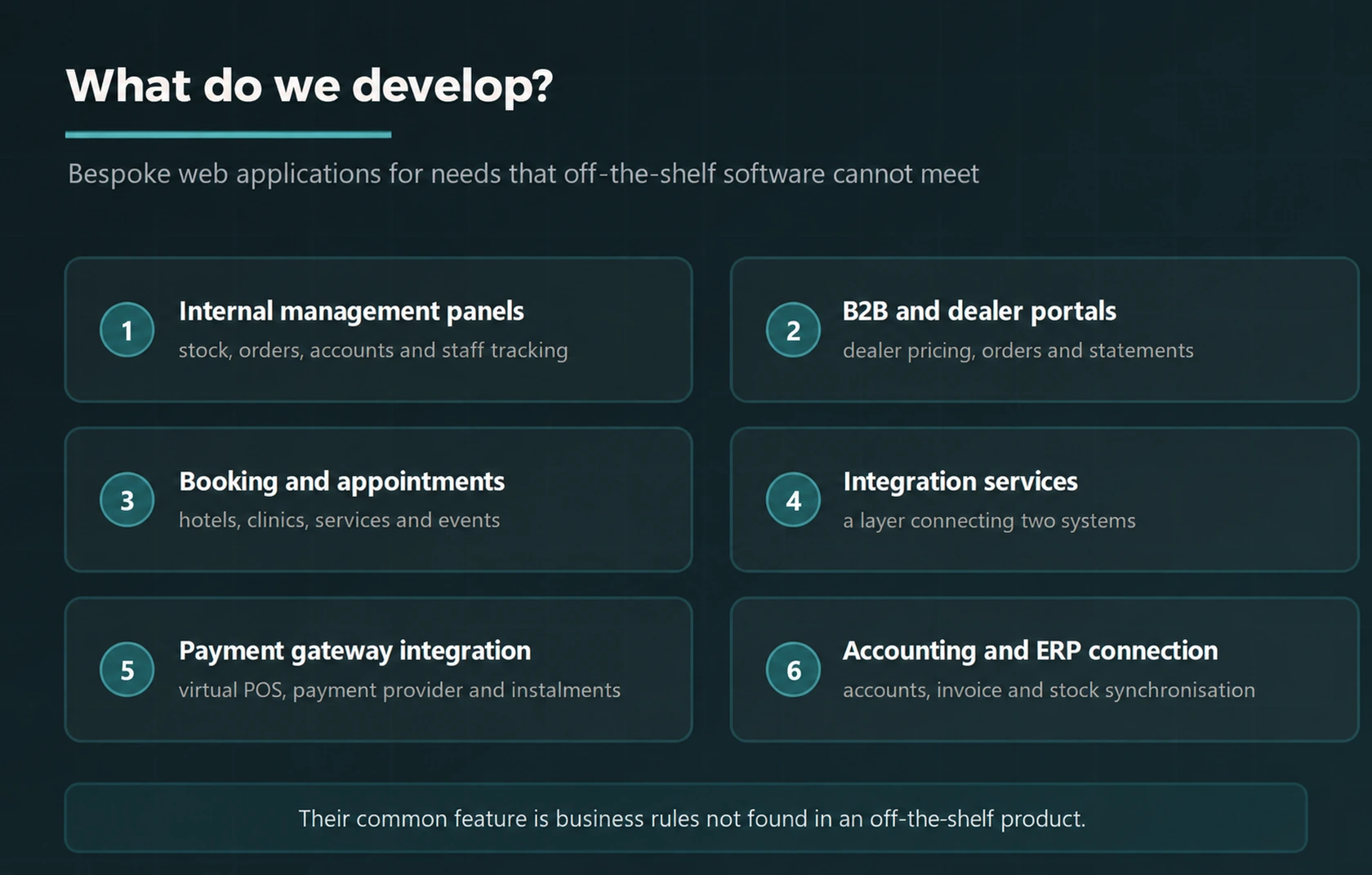
Internal Management Panels
Panels where processes such as stock, orders, customer accounts, personnel, and task tracking are managed from a single screen, separated according to permission levels. This is the place where jobs most frequently handled via Excel files are moved.
B2B and Dealer Portals
Closed systems where dealers see their own price lists, place orders, and track their statements and balances. Each dealer only sees their own data.
Reservation and Appointment Systems
Appointment structures with calendar, capacity, and conflict control in areas such as hotels, clinics, services, and events; together with reminder notifications.
Integration Services
Middleware software that sits between two systems that cannot communicate directly. It transforms, validates, queues the data, and retries in case of errors.
Payment Channel Integrations
Connecting bank virtual POS systems and payment institutions to your application; installment rules, 3D Secure flow, refund and reconciliation processes.
Accounting and ERP Connections
Two-way synchronisation of current account, invoice, stock, and collection data with accounting or ERP software. The task of entering the same data in two places manually is eliminated.
What Does the Integration Service Do?
One of the most frequent requests we receive is: “Let this system see that system.” It sounds simple, but when two software systems do not speak the same language, a layer needs to be added in between.
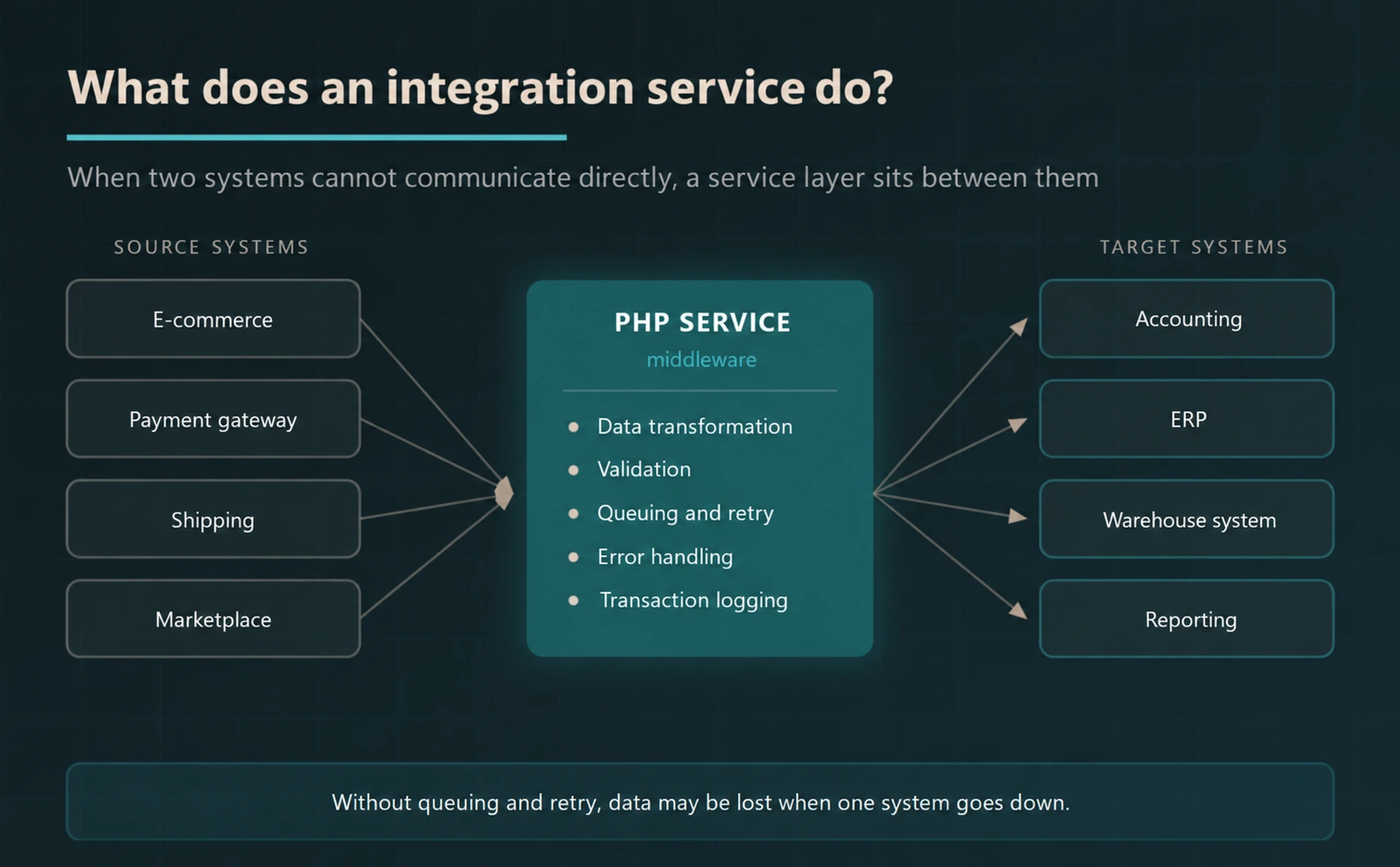
The most overlooked part of this layer is error management. If the other system does not respond, the API limit is reached, or unexpected data is received, and there is no pre-defined plan, the integration quietly stops and no one notices for days. In the services we set up, queueing, retrying, and transaction logging are standard.
Scope of Our Service
- Process Analysis
The current operation is observed; which steps will be transferred to software and which will remain are determined. - Technology Selection
The appropriate option is selected from Laravel, Symfony, or a frameworkless approach depending on the size and lifetime of the project. - Data Model Design
The database structure is established; this is the most expensive part to change later, so it is designed correctly from the start. - Interface Development
Screens are designed to speed up daily use; the most frequently performed action is done with the fewest clicks. - Authorisation
User roles and access levels are defined; it becomes clear who can see and change what. - REST API Development
If a mobile application or other systems will connect, an authorised and versioned API is written.
- Integrations
Payment, shipping, accounting, ERP, and marketplace connections are established along with queue and error management. - Data Transfer
Existing Excel files or records from the old system are transferred to the new structure. - Testing and Deployment
It is tested with a copy of the real data, first released to a limited number of users, then rolled out widely. - Server Setup
The environment where the application will run is set up and security configuration is performed. - Training and Documentation
User training is provided, technical documentation is delivered. - Maintenance and Development
Post-release bug fixes and new requirements are carried out under the maintenance agreement.
Who Owns the Source Code?
Yours. We deliver the source code and database structure of the application we developed. The operation of the application does not depend on us; if you wish, you can continue with another team.
We see this not as flexibility, but as the correct way of working. Instead of keeping the customer with technical dependency, we prefer to keep them by doing the job well.
When obtaining a quote for the existing PHP project
The development cost of an existing application does not depend solely on the new screens requested. The PHP and framework version, dependencies, database structure, tests, and the condition of the existing code should also be examined. A fixed time estimate given without seeing the code can be misleading.
Access permissions for analysis, sample workflows, known errors, and a list of connected services should be prepared. If production data will be shared, access limits and necessary data masking should be determined in advance.
The delivery plan should include database changes, test environment, deployment to production, and rollback steps. Clarifying API documentation, source code, installation information, and maintenance responsibility makes it easier for the application to be maintained by subsequent developers.
Frequently Asked Questions
What is PHP application development?
It is the writing of business applications that run through a browser and do not require installation using the PHP language. The user goes to an address and logs in; the program is not installed on every computer, updates are made from a single point. Internal management panels, B2B portals, reservation systems, and integration services are developed within this scope.
Do you use Laravel or Symfony?
We use both; the choice depends on the project. Laravel allows fast progress in medium and large-scale projects with its ready-made components and extensive ecosystem. Symfony, with its stricter and more predictable structure, is preferred in long-lasting corporate systems and large teams. In small and single-purpose tools, it might be more appropriate to write pure PHP without using a framework.
Can my mobile application connect to this system?
Yes. We are developing a REST API for this: an authorised, versioned, and documented service layer is written; the mobile application also connects to this service. The same API can also be used for data exchange with other systems. Can the mobile side itself integrate with our accounting program? mobile application development .
Usually, yes. If the accounting or ERP software has an API, a data transfer file, or database access, current accounts, invoices, inventory, and collection data can be synchronized bidirectionally. The first step is to examine which integration method your software supports.
Do you provide virtual POS and payment integration?
Yes. We set up the bank’s virtual POSs and the connection of payment institutions to your application, define installment rules, the 3D Secure flow, and the refund and reconciliation processes. Error management on the payment side is critical; what happens to failed transactions is defined from the start.
How long does the project take?
It depends on the scope. While an internal tool consisting of a single screen can be delivered in a few weeks, a multi-user and integrated portal may take months. The factor that mostly determines the duration is not the number of screens, but the clarity of the business rules; that’s why we allocate time for the analysis phase.
Are we given the source code?
Yes. We deliver the source code and database structure of the developed application. The operation of the application does not become dependent on us; if you wish, you can continue with another team.
What's the difference from the custom software development page?
Custom software development page explains our general approach, the range of technologies we use, and the way we work. This page, however, focuses especially on the PHP side, that is, web-based applications running in the browser. If your project requires desktop, mobile, or a different technology, the other page is more comprehensive.
Our Relevant Services
For our general approach custom software development, for the mobile side mobile application development, for process automation special software automations, for AI integrations artificial intelligence integration, for the sales side custom software e-commerce systems and for the infrastructure where the application will run cloud server services You can check our pages.
Explain Your Process, That’s Enough
You don’t need to prepare a technical specification. It’s enough to explain how the work is running right now, where it is stuck, and who will use which screen; we will handle the technology selection and the setup.
To meet you can contact us.