


SaaS application development
Cloud Bilişim develops subscription-based SaaS applications for businesses in Türkiye. The scope covers multi-tenant architecture, user permissions, subscription plans and payment flows, with data isolation and operational responsibilities defined around the product’s business model.
What must be planned before building a SaaS product?
Define tenant boundaries, account roles, subscription plans and usage limits before development. Billing failures, data export, backup and account closure also need agreed behaviour so the product can be operated after launch.
How do SaaS operating models compare?
| Model | Deployment | Operational consideration |
|---|---|---|
| Single-customer application | Separate instance for each customer. | Customer-specific updates and infrastructure. |
| Multi-tenant SaaS | A shared application serving separate customer accounts. | Tenant isolation, shared releases and subscription management. |
Related services and next steps
Custom e-commerce development, Business process automation, Contact Cloud Bilişim.
What is SaaS?
SaaS (Software as a Service) is the delivery of software to customers via subscription over the internet, instead of selling it through installation. The customer goes to an address, opens their account, and starts using it; installation, updates, and maintenance are entirely handled on your side.
The appeal of this model is in the revenue: instead of a one-time sale every month recurring revenue. But what makes SaaS difficult is exactly this — selling the product happens once, maintaining the subscription is repeated every month.
On the SaaS side, we do three separate things: for a startup or a company we develop a SaaS product from scratch, we offer the products we developed ourselves via subscription and existing software installed for a single customer we transform it into a multi-tenant SaaS model.
What is Multi-Tenant Architecture?
This is the technical core of SaaS. A single application serves many customers; each customer’s data is strictly isolated from each other.
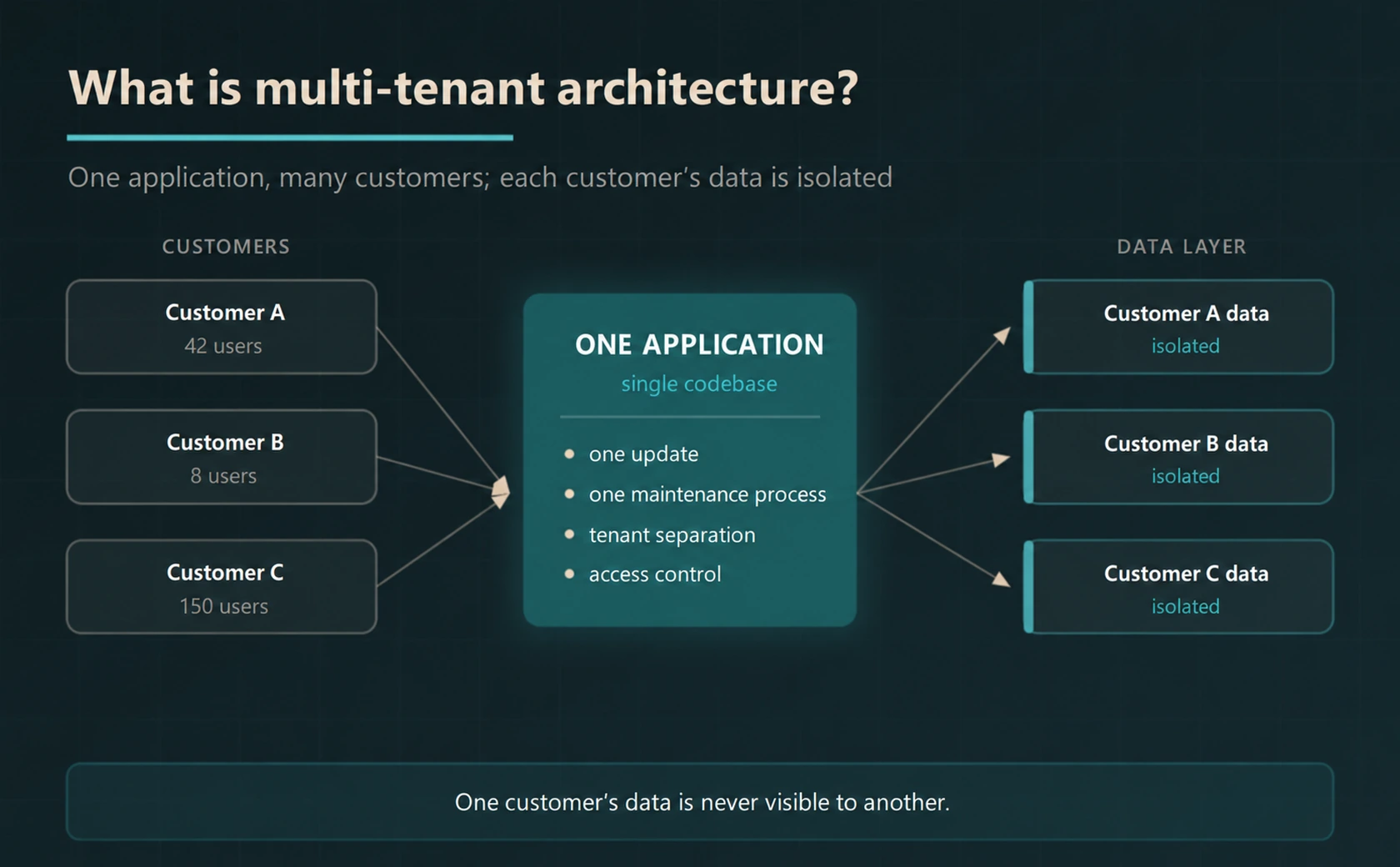
The business equivalent of this structure is: single update, all customers. When you write a new feature, you do not set it up separately for a hundred customers. On the other hand, a single error affects all customers at once; therefore, testing and phased release processes are established from the beginning.
Tenant separation is the most critical part of the software. A query accidentally returning another customer’s data is the most severe error that can occur in SaaS. For this reason, separation is applied not in just one place but separately at the data layer and the authorisation layer.
Subscription and Billing
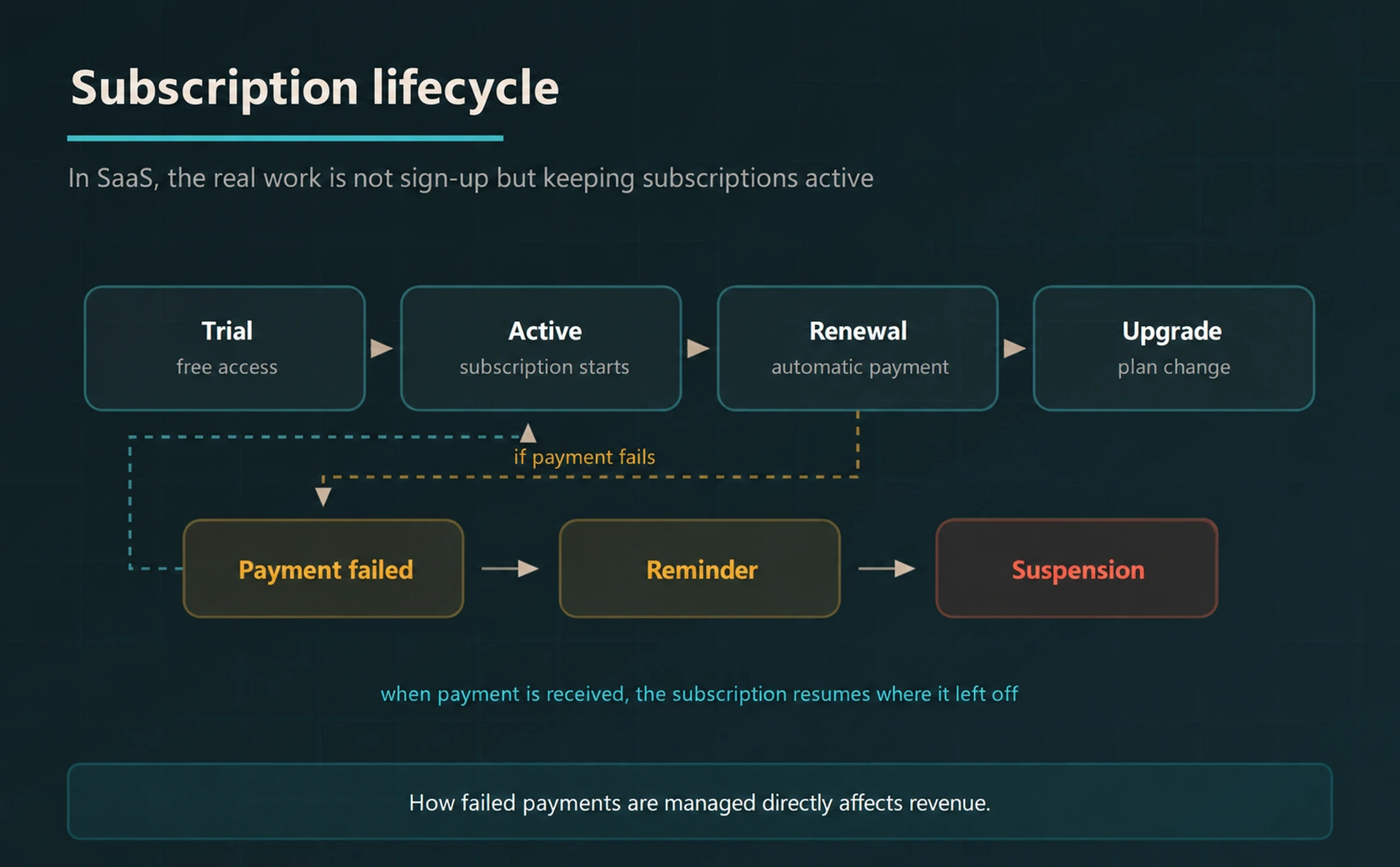
In SaaS, the real task is not to acquire records but to maintain the subscription. This is also the most overlooked part of the software: what happens when a payment fails.
Package and Pricing
Packages, in-package limits, and price tiers are defined. How the remaining time will be calculated in upgrade and downgrade operations is designed from the start.
Trial Period
A trial period is defined either requesting card information or without requesting it; it is determined what will happen to the account at the end of the period and how long the data will be stored.
Automatic Collection
Recurring collection is established through a virtual POS or payment institution. Steps like reminders, retrying, and suspension automatically operate in case of failed attempts.
Billing
For each collection, e-Invoice or e-Archive is automatically issued and delivered to the customer; a data flow to the accounting side is established.
Usage Measurement
In some SaaS products, the price is not fixed; it varies according to the number of users, the number of transactions, the storage space, or API calls. In this case accurate measurement of what is used It is a matter of direct income.
In the structures we set up, usage is counted in real time, shown to the customer on their own panel, and a warning is given when approaching the limit. What happens in case of exceeding the limit — whether blocking or extra charge — is predefined. Measurement records are kept consistent with the invoice; there is a record to show when the customer says, ‘I didn’t use this much.’
Converting the Existing Software to SaaS
If you have software that is set up separately for each customer, it is possible to convert it into a subscription model. This is a decision that also changes your sales model.
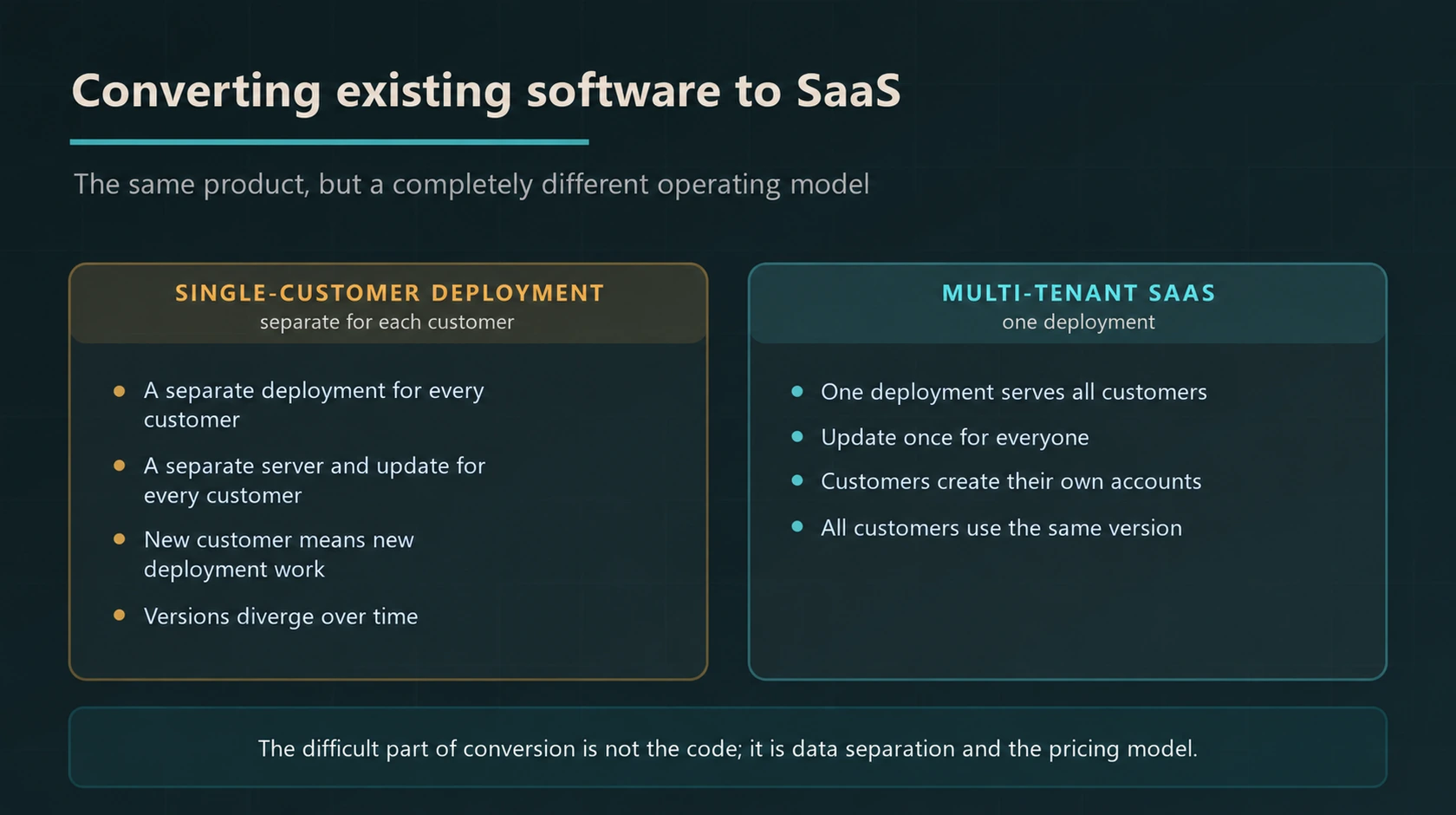
The difficult part of the transformation is often not the code. The real challenge lies in three places: the addition of data separation to the existing structure later, the redesign of the pricing model and migrating existing customers to the new structure . Transformations that start without planning these three usually remain unfinished.
We also start our work not by writing code, but by examining your existing software and customer structure.
Scalability and Infrastructure
In SaaS, as the number of users increases, the infrastructure needs to grow as well. But setting up a large infrastructure from the start means spending money for customers who haven’t arrived yet.
The correct approach is, allowing to grow but initially small It is to build a structure: the application layer is written to scale horizontally, the database and file storage are kept separate, and when resource needs increase, the server is scaled up.
Established on the Infrastructure Side
- Application structure suitable for horizontal scaling
- Separate database and file storage layer
- Queue system and background jobs
- Monitoring, alerting, and error tracking
- Automatic backup and recovery test
- Possibility of gradual release and reversal
Scope of Our Service
- Product and Model Description
Who it will be sold to, with which packages, and according to which pricing logic is clarified; technical decisions are built upon this. - Multi-Tenant Architecture Design
How tenant separation will be implemented at the data and authorisation layer is designed. - Registration and Account Management
Self-registration, email verification, inviting users, and role management are established. - Subscription and Payment
Packages, trial periods, automatic collection, upgrade, and cancellation flows are developed. - Usage Measurement
Quota tracking, limit alerts, and usage-based billing infrastructure are set up. - Admin Panel
A management screen is developed on your side where customer, subscription, and revenue tracking are performed.
- API and Integrations
An authorised API is developed for customers to connect to their own systems. - Infrastructure Setup
Cloud infrastructure suitable for growth, monitoring, and redundancy is established. - Security
Data isolation tests, authorisation audits, encryption, and access logs. - SaaS Transformation
Migration of existing single-installation software to a multi-tenant model and customer migration. - Gradual Release
New versions are first released to a limited number of customers; if there is a problem, they are rolled back. - Continuous Development
Development, monitoring, and support continue even after the product goes live.
We Recommend Starting Small
The most common mistake in SaaS projects is trying to write the first version with all the dreams included. Whether the product released months later will find a market response is still unknown.
Instead, we recommend starting with the smallest sellable version and growing with feedback from real customers. We build the architecture ready for growth; thus, starting small does not mean rewriting later.
Delivery scope when choosing a SaaS development company
The operation of a SaaS product is not just about opening the membership screen. Ask whether scenarios such as separating customer data while comparing offers, changing plans, failed payments, subscription cancellation, and data export are included in the scope.
For the MVP, first describe how a single customer will derive value from the product. Then clarify user invitations, role management, and usage limits. Acceptance tests should include situations such as access limits between different customer accounts and repeated payment notifications.
Separate the development budget from the operating budget: hosting, email, payment provider, monitoring, and support costs can vary with the number of users. Clearly specify in the contract the source code, cloud accounts, documentation, and maintenance responsibilities.
Frequently Asked Questions
What is SaaS?
SaaS (Software as a Service) is, instead of selling software to the customer through installation, allowing it to be used via subscription over the internet. The customer opens their own account and starts using it; installation, updates, and maintenance remain on the provider’s side. The revenue model is based on recurring subscriptions rather than one-time sales.
What does multi-tenant architecture mean?
It is the fact that a single application serves many customers and that each customer’s data is kept isolated from each other. This way, a single update reaches all customers, and separate installations are not done for each customer. Tenant separation is applied separately both in the data layer and in the authorisation layer; having a query return another customer’s data is the most serious error that can occur in SaaS.
Are you setting up the subscription and collection system?
Yes. Packages and limits, trial period, recurring collections through virtual POS or payment institution, calculation of remaining time in upgrades and downgrades, cancellation flow, and automatic billing are included in this scope. Steps such as reminders, retry attempts, and suspension in case of failed collections also operate automatically.
Can usage-based pricing be applied?
Yes. Pricing can be established based on criteria such as the number of users, number of transactions, storage space, or API calls. Usage is counted in real time, displayed to the customer in their own panel, warnings are given when approaching the limit, and what happens in case of exceeding the limit is predefined. Measurement records are stored in a manner consistent with the invoice.
Can you convert my existing software to SaaS?
Generally yes. The difficult part is not the code; it is adding data separation to the existing structure afterward, reconfiguring the pricing model, and migrating already established customers to the new structure. Transformations started without planning for these three often remain unfinished, so we start the work by examining the existing software and your customer structure.
Up to how many customers can it scale?
The scalability capacity depends on the architecture, database, and infrastructure limits; as the resource requirement increases, the growth plan is updated with load tests. What is important is that the application is written to be suitable for horizontal scaling, that the database and file storage are kept separate, and that heavy tasks are queued. Initially, it starts with a small infrastructure; as growth comes, it is expanded.
Do you have your own SaaS products?
Yes, we have products that we have developed ourselves and offer through subscription. This means that we know SaaS not only as a customer project but also as the operating side; our experience with subscription management, collection issues, and growth dynamics comes from this.
How long does it take to go live?
Depends on the scope. We recommend starting with the smallest saleable version; this can usually be launched within a few months. Projects that try to rewrite all the features from scratch, however, take months and it is still unknown whether they will succeed in the market. Since we build the architecture ready for growth, starting small does not mean having to rewrite it later.
Our Relevant Services
For our general approach custom software development, for the server-side PHP application development, if a mobile application is needed mobile application development, for artificial intelligence features artificial intelligence integration, for infrastructure cloud server services and for data security cloud backup You can check our pages.
Let’s Talk About Your Product Idea
Who will you sell to, which problem does it solve, how will the price be determined, and what really needs to be in the first release? In SaaS projects, the correct answers come from these questions; we base our technical decisions on this.
To meet you can contact us.